Venus is the second planet from the Sun and is often referred to as Earth’s ‘sister’ due to their similar size. However, its true appearance remained an enigma for a long time. Thick clouds of sulfuric acid completely conceal its surface, preventing anyone from seeing the planet in visible light. Most space missions to Venus have focused on exploring the invisible parts of the spectrum—ultraviolet, infrared, and radio waves. These wavelengths provide scientists with far more information about the planet’s atmosphere and surface than ordinary light could.
Nonetheless, the question of what Venus would look like to the human eye persisted. Only a handful of spacecraft have captured images in visible light, and even fewer managed to produce a true-color image resembling what a person might see if they were close to the planet.
The photograph that changed our view of Venus
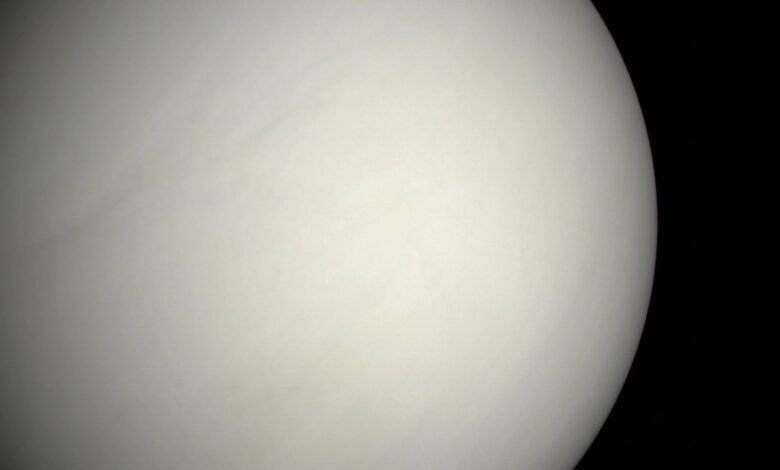
In 2007, the MESSENGER interplanetary probe—primarily a mission to study Mercury—performed a flyby of Venus. During this maneuver, scientists used the on-board MDIS-WAC wide-angle camera to photograph the planet. In a short period, the probe captured over 600 images across 12 different parts of the electromagnetic spectrum.
To create a color image that most closely matches human vision, experts selected three photos taken with filters at wavelengths of 480, 559, and 629 nanometers. These values correspond to blue, green, and red colors. By combining them, researchers produced an RGB composite, allowing viewers to see Venus as it would appear to the naked eye without special instruments.
Why Venus Looks This Way
In the resulting image, the planet appears shrouded in a dense haze with soft yellow and beige hues. This coloration is caused by the planet’s atmospheric features: clouds made of sulfuric acid reflect and scatter sunlight, giving Venus its characteristic muted tone. Unlike Mars, with its striking red surface, or Earth’s blue oceans, Venus appears subdued and even somewhat mysterious.
The human eye, if placed near the planet, would see this very scene — not brightly colored, but with a distinct cloud structure that constantly moves across the sky at speeds of up to 360 kilometers per hour. The surface remains completely hidden, and only special tools can penetrate the thick cloud cover.
Technology That Reveals the Secrets of Planets
Using different filters and spectral ranges allows us to capture images that are impossible to see with the naked eye. For scientists, this is not just a way to visualize, but also a tool for analyzing atmospheric chemical composition, temperature, and other parameters. Thanks to technologies like the MDIS-WAC camera, researchers can create not only scientific, but also visually stunning images that bring us closer to understanding other worlds.
Modern spacecraft are equipped with increasingly advanced cameras and spectrometers, enabling highly accurate data collection. Every new image is a step closer to uncovering the nature of the Solar System’s planets and expanding our knowledge of the universe.
Venus Through the Eyes of Future Explorers
Although no human has visited Venus yet, images like these help us imagine what the experience might be like. Scientists continue to develop new missions that will get even closer to the planet in the future and may even send new-generation robotic landers to its surface. Leading space agencies around the world are already discussing such projects.
Venus remains one of the most mysterious and least explored planets. Its extreme conditions—intense heat, pressure, and acidic clouds—make exploration especially challenging. Nevertheless, interest in the planet is undiminished, and each new image brings humanity one step closer to unlocking its secrets.
In case you didn’t know, the MESSENGER spacecraft was developed and launched by NASA (the United States National Aeronautics and Space Administration) in 2004. Its primary mission was to study Mercury, but on its way, it flew past Venus twice, providing unique data about the second planet from the Sun. The spacecraft was equipped with advanced scientific instruments, including high-resolution cameras and spectrometers, making it one of the most successful projects for studying the inner planets of the Solar System. MESSENGER completed its mission in 2015 by crashing onto Mercury’s surface, but the data it collected is still being analyzed by scientists worldwide. Thanks to this research, our understanding of the planets closest to the Sun has become much broader and deeper.