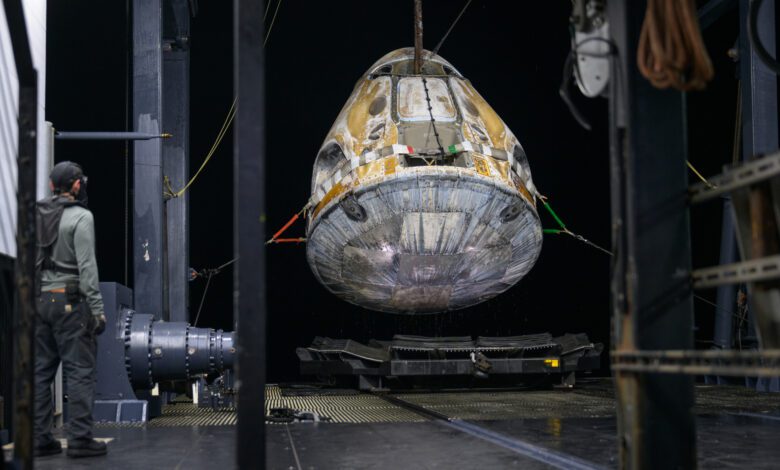
The four crew members of the Crew-11 mission, launched to the International Space Station (ISS) by SpaceX, have already returned to Earth after the first-ever medical evacuation from orbit. Their return marked an unexpected turn in the expedition, which was supposed to last longer but was cut short due to the health of one of the crew members. The decision for an early return was made after it became clear that the necessary diagnosis and treatment were impossible under station conditions.
The Crew Dragon Endeavour capsule made a soft landing in the Pacific Ocean near San Diego on Thursday, January 15. NASA was quick to emphasize that the situation was not critical and there was no threat to life, but standard safety procedures required an immediate response. After splashdown, agency representatives confirmed that all astronauts were feeling well, and the incident demonstrated NASA’s preparedness for any unexpected situations.
Mission and challenges
At a post-landing press conference, NASA chief Jared Isaacman noted that the astronaut who prompted the evacuation is already recovering. He promised to share more details when possible, but stressed that the agency’s ability to quickly and safely bring the crew back is the result of years of preparation and emergency scenario training. “That’s exactly what we train for. This is NASA at its best,” Isaacman said.
Deputy manager for space operations Joel Montalbano added that over 170 days in orbit, the crew spent almost 900 hours conducting scientific research, covering around 140 different experiments. These efforts not only push the boundaries of knowledge but also lay the groundwork for future missions — including the Artemis program, which aims to return humans to the Moon and explore Mars.
Science and training
Isaacman reminded that space flights are always associated with risk and unpredictability. That is why NASA pays special attention to preparing for emergency situations. According to him, the successful completion of the Crew-11 mission directly confirms the effectiveness of these measures. “We go to space to learn. And we must be ready for any surprises,” he emphasized.
Montalbano noted that the experience gained will be used in preparing the next expeditions. The launch of Crew-12, which was supposed to replace Crew-11 on board the ISS, is already scheduled for February. However, due to the early return, the crew rotation did not take place, and currently only three people are working at the station: American Chris Williams and Russian cosmonauts Sergey Kud-Sverchkov and Sergey Mikayev. For the first time in nearly twenty years, the ISS is operating with such a small crew.
The future of missions
NASA is already preparing for its next major mission — Artemis 2, which will be the first crewed flight to the Moon since 1972. The launch is scheduled for February 6, and both upcoming expeditions will lift off from the spaceport on Florida’s coast. The agency believes that the experience from Crew-11 will help make future flights even safer and more efficient.
The situation with the crew’s early return served as a reminder of how critical flexibility and adaptability are in space programs. Despite the sudden challenges, the team accomplished their mission, and the entire operation became a model of coordination and high professionalism.
RUSSPAIN reminds readers that NASA (National Aeronautics and Space Administration) is the United States’ national body for aeronautics and space exploration, established in 1958. The agency is responsible for civil space programs, research and exploration, as well as developing new technologies for both crewed and robotic missions. Over recent decades, NASA has carried out hundreds of projects, including landing humans on the Moon, sending rovers to Mars, and building the International Space Station.