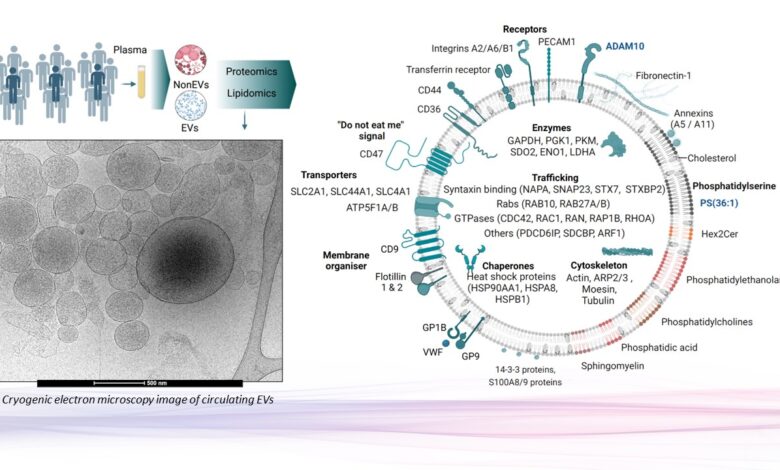
Every second, an invisible exchange of information takes place inside the human body. Cells send each other tiny messages packaged in special bubbles called extracellular vesicles. These microscopic structures, filled with proteins, fats, and fragments of DNA, travel through the bloodstream carrying information about the condition of their ‘senders.’ Until recently, scientists could only guess how this delivery system actually worked and what exactly was inside these parcels.
The problem was that blood is an extremely complex environment. In addition to vesicles, it contains thousands of other particles—from lipoproteins to cell debris. This made accurate analysis very challenging. Previously available methods only allowed a rough estimate of blood composition, making it impossible to single out the specific molecules that belonged to vesicles.
A group of researchers decided to change the approach. Their goal was to create a detailed map of unique components found only in extracellular vesicles. This step would not only allow scientists to distinguish vesicles from other particles but also use that information for early disease diagnosis.
Methods and discoveries
To achieve this goal, the scientists employed density fractionation. This method allowed them to carefully separate blood plasma into distinct layers, each containing particles of a specific size and weight. As a result, they obtained pure vesicle samples free from extraneous contaminants.
Next, mass spectrometry was used—a highly precise tool capable of “weighing” and identifying the smallest molecules. This enabled the researchers to perform a detailed analysis of the contents of vesicles and other blood particles. As a result, they compiled a list of 182 proteins and 52 lipids that consistently occur inside extracellular vesicles. This set became known as the universal molecular signature.
At the same time, another list was identified—molecules found exclusively in “debris” particles that are not vesicles. This distinction, for the first time, made it possible to clearly separate cellular communication signals from the background noise present in plasma.
Key markers
The most significant result of the study was the discovery of two unique markers that enable absolute identification of extracellular vesicles. These are the ADAM10 protein and a specific type of phospholipid—phosphatidylserine PS(36:1). Testing of blood samples from patients with early signs of coronary artery disease showed that these markers persist even with physiological changes.
The creation of such a map of molecular markers opens up new horizons for medicine. Now, doctors and biologists can quickly and accurately determine the composition of vesicles, which is especially important for early detection of pathologies. In the future, similar maps may allow us to track even the slightest changes in the state of internal organs long before symptoms appear.
Practical significance
The authors of the study have developed a special online resource that compiles all the information about the discovered markers. Any specialist can now use this database to analyze their patients’ blood. This approach significantly speeds up the diagnostic process and makes it more accurate.
Understanding how cells exchange information at the molecular level is changing our ideas about how the body functions. This discovery enables not only early detection of diseases, but also the development of new treatments based on controlling intercellular communication.
The future of diagnostics
Extracellular vesicles are becoming a key tool for doctors. Their molecular signature—a kind of cellular ‘barcode’—allows us to obtain health information without complex or invasive procedures. Specialists already note that such technologies could form the basis for new tests and methods to monitor chronic diseases.
In the coming years, vesicle marker maps are expected to become a standard practice in laboratory diagnostics. This will not only allow for faster detection of dangerous conditions, but also enable real-time monitoring of treatment effectiveness.
If you weren’t aware, Naked Science is one of the leading popular science projects covering the latest advancements in biology, medicine, and technology. The publication regularly features articles on breakthrough research and provides expert commentary from specialists around the world. Thanks to its team of journalists and scientists, Naked Science helps a wide audience understand complex questions in modern science.