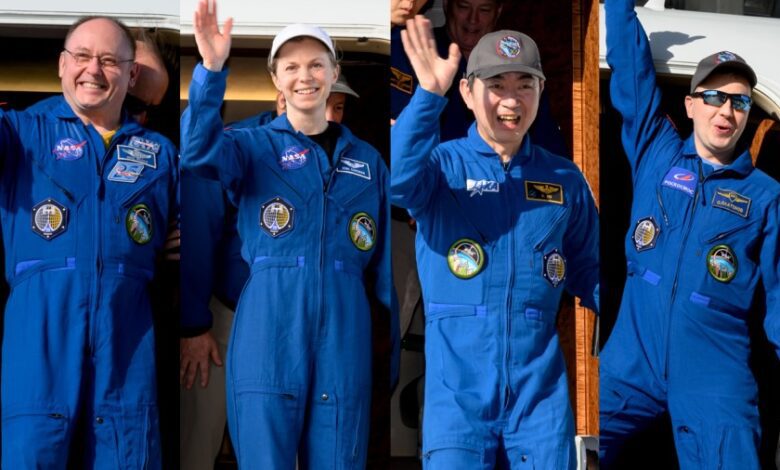
In early January 2026, an incident occurred on the International Space Station (ISS) that changed the established course of space missions. For the first time in the history of continuous human presence in orbit, a crew member was evacuated for medical reasons. NASA made the decision to end the Crew-11 mission early and return all four astronauts home aboard a SpaceX Dragon capsule. Details about the astronaut’s health condition have not been disclosed, as the agency adheres strictly to confidentiality. However, the very fact of the evacuation raises important questions: how dangerous are illnesses in space, and why are such cases so rare?
Before the flight, each candidate undergoes a multi-level medical examination. Doctors assess not only physical endurance but also psychological resilience and the risk of chronic conditions worsening in zero gravity. Although serious medical incidents theoretically could happen on the ISS about once every three years, in practice, such situations are extremely rare.
Health in orbit
Each mission to the station is supported by medical teams both on Earth and on board. There is always a crew member responsible for medical procedures—sometimes a professional physician, sometimes a specially trained astronaut. They know how to conduct examinations, provide first aid, and use telemedicine to consult with specialists on Earth.
What problems most often trouble astronauts? Research shows that most complaints are related to the skin. Dryness, irritation, allergic reactions, and delayed wound healing occur 25 times more frequently than on Earth. The reason is the station’s dry, cold air and limited hygiene options: instead of a shower, only wet wipes and special products are available.
Zero Gravity and Its Traps
Almost every astronaut experiences nasal congestion and headaches during the first days of a mission. In microgravity, blood and fluids rush to the head, causing facial swelling and so-called ‘space congestion.’ This leads to a reduced appetite, disturbed sleep, and general fatigue.
Sleep on the ISS is a separate challenge. The station orbits Earth 16 times per day, with day and night changing every 90 minutes. As a result, circadian rhythms are disrupted, and the constant noise from equipment and cramped quarters only make things worse. On average, astronauts get one to two hours less sleep than on Earth.
Injuries and Risks
Injuries in orbit are not uncommon, although most are minor. According to NASA, over two hundred minor injuries have been recorded during years of work on the ISS, most frequently involving the hands—cuts, abrasions, or bruises sustained while moving between modules or handling tools. Paradoxically, mandatory physical exercise, designed to protect bones and muscles from atrophy, is the leading cause of these injuries. Crew members spend up to two hours daily exercising to slow the loss of bone mass—in microgravity, it decreases by about 1% per month, especially in the pelvis and spine.
Spacewalks (EVAs) also come with risks. Statistically, for every four spacewalks, there is one injury—most often caused by spacesuit components. Scientists continue to look for ways to make exercise and work outside the station safer.
Unique diseases found only in space
There are also conditions specific to space. One is spaceflight-associated neuro-ocular syndrome (SANS), triggered by weightlessness. Up to 70% of astronauts on long-duration missions experience vision changes due to increased pressure on the optic nerve. In some cases, these effects persist even after returning to Earth.
In 2020, an incident occurred that shook the medical community: during a routine check-up, one of the astronauts was found to have a thrombus in the jugular vein. There were no symptoms, and the diagnosis was made by chance. Treatment lasted for over three months—doctors on Earth remotely supervised the administration of medication, and the necessary drugs were delivered to the station by a cargo spacecraft. The astronaut performed ultrasounds on himself under the guidance of specialists from Earth and successfully completed his mission.
The Future of Space Medicine
The emergency evacuation of Crew-11 served as a reminder: even the most advanced technologies cannot fully eliminate health risks in space. In the coming years, NASA and other agencies plan to send crews beyond low Earth orbit—to the Moon and Mars. There, help from Earth will be out of reach, necessitating a new approach to medical support. Autonomous diagnostic and treatment systems, including those powered by artificial intelligence, are already in development.
Nevertheless, the fact that only one urgent evacuation has been needed in 25 years of continuous missions speaks to the extremely high level of training and medical support. However, space remains a hostile environment for the human body, and sometimes even the most experienced crews are forced to return home ahead of schedule.
RUSSPAIN reminds that NASA (National Aeronautics and Space Administration) is the United States’ national agency for aeronautics and space exploration, founded in 1958. The agency is responsible for civilian space programs, research, and space exploration, as well as the development of new technologies for both crewed and robotic missions. NASA actively collaborates with international partners, including the European Space Agency, Russia, Japan, and Canada, on projects for deep space research and the operation of the ISS.