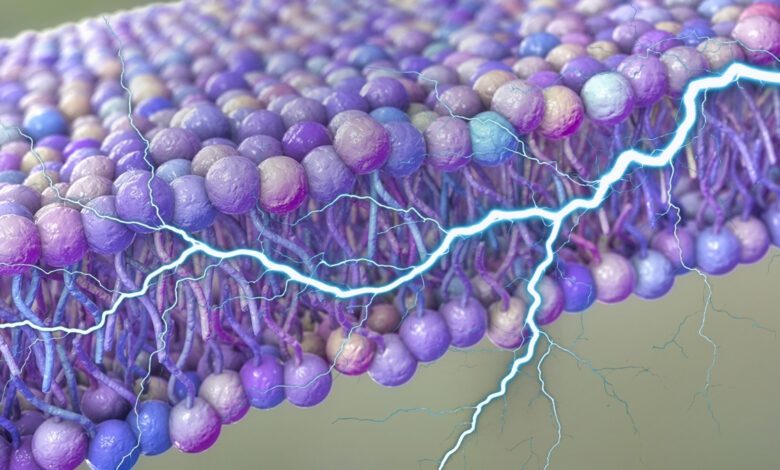
Within each of us, down to the smallest structures, there may be more at play than just biochemistry. American researchers from the University of Houston and Rutgers University have put forward a bold hypothesis: cell membranes can generate electricity, which the body uses to send signals and move substances. This isn’t just another scientific guess—calculations show that tiny waves forming on the surface of lipid membranes can create voltages comparable to those that trigger nerve impulses.
The key is that cell membranes aren’t static barriers, but dynamic structures constantly in motion. Their vibrations are driven by the action of proteins and the consumption of ATP molecules—the universal energy carrier. Until now, it was thought such fluctuations were too chaotic to be useful. However, the new theory argues the opposite: these microscopic movements may create potential differences that cells can harness for their own needs.
If this hypothesis proves true, our understanding of how the body works will have to change. It turns out that every cell is not just a chemical laboratory, but also a miniature power plant.
The Physics of Life
The new perspective is based on a phenomenon known as flexoelectricity. This term refers to the ability of certain materials to generate an electric charge when bent or deformed. In nature, this effect is rare, but according to scientists, cell membranes are ideally suited for its manifestation.
Under normal conditions, when everything is in equilibrium, the resulting voltage quickly dissipates. But cells are not closed systems. Inside, ongoing processes disturb this balance: proteins move, ions shift, and energy is consumed. As a result, membranes bend and vibrate, which means they can generate electricity.
Calculations show the difference in potential between the inner and outer sides of the membrane can reach 90 millivolts. For comparison, that’s enough to trigger an electrical impulse in a neuron. This means that membranes themselves can not only transmit signals but also initiate them.
The energy of movement
A key takeaway: the electricity that arises in membranes can be used to transport ions—charged particles that play a vital role in muscle function, nerve signal transmission, and other essential processes. And these processes occur at incredible speed—on a millisecond scale, perfectly matching the rhythm of the nervous system.
Scientists suggest that this mechanism could be universal for all living organisms. Moreover, if membranes are indeed capable of generating electricity, this may explain how cells coordinate their actions within tissues and organs. It is possible that this effect allows organisms to respond rapidly to external stimuli and maintain internal equilibrium.
For now, this remains a theoretical model, but it already opens up new horizons for research. In the near future, scientists plan to test their hypotheses in practice to determine how strongly electrical oscillations of membranes affect the functioning of the entire organism.
A Source of Inspiration for Technology
The discovery isn’t limited to biology alone. Researchers believe that if this mechanism can be replicated in artificial materials, it will pave the way for new types of devices—from bio-inspired sensors to energy-efficient computing systems. For example, neural networks designed based on how cell membranes work could process information faster and more efficiently than modern computers.
Furthermore, understanding how cells use electricity could lead to new methods for treating disorders related to impaired signal transmission—such as neurological diseases or muscle disorders. In the long term, this could become the foundation for developing fundamentally new medications and therapeutic approaches.
However, scientists are only just beginning to unravel the mysteries of cell membranes. Each new experiment brings us closer to understanding how life works at its most fundamental level.
The future of research
There are still more questions than answers. How exactly do cells use the voltage that arises? Is it possible to control this process from the outside? What other hidden sources of energy exist in the body? Answers to these questions could transform not only medicine, but also the technology of the future.
For now, one thing is clear: nature never ceases to amaze with its ingenuity. What once seemed like chaotic noise may actually be a key element in the intricate system governing life. And perhaps it is these microscopic fluctuations that hold the secret to the resilience and adaptability of living beings.
In case you didn’t know, the University of Houston is one of the leading research universities in the United States, specializing in interdisciplinary projects in biophysics, nanotechnology, and medicine. Its laboratories regularly make discoveries that reshape our understanding of the human body’s capabilities and open new avenues for the advancement of science and technology.