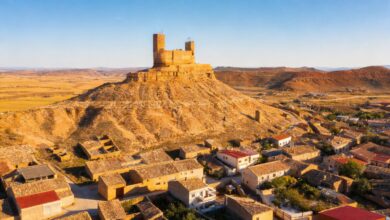
On the banks of the Duero River, in the very heart of the autonomous community of Castilla y León, lies the fortified city of Almazán, which has preserved its unique medieval charm. Its imposing walls, fortified gates, and majestic squares make it a must-visit destination for anyone interested in the history and cultural heritage of Spain. A stroll through the old town feels like a journey back in time, where Romanesque and Gothic architecture blend harmoniously with picturesque natural landscapes.
The name of the city, with Arabic roots, translates as “fortified place,” fully reflecting its historical past. In the Middle Ages, Almazán was an important strategic location contested by Christians and Muslims. To this day, its impressive defensive complex remains, including gates such as Puerta del Mercado and Puerta de Herreros. The ensemble is completed by the famous cylindrical tower known as Rollo de las Monjas, rising above the river. From here, a panoramic route begins along the walls, offering magnificent views of the surrounding area.
The heart of urban life is the Main Square (Plaza Mayor), a classic example of Castilian architecture. Here, you’ll find two landmark buildings: the Hurtado de Mendoza Palace (Palacio de los Hurtado de Mendoza), built in the Gothic-Renaissance style, and the Romanesque Church of San Miguel (Iglesia de San Miguel), which has been a National Monument since 1931. The church impresses with its mix of styles: its structure shows both Cistercian influences and Mudéjar elements, particularly evident in its unique dome.
Apart from this, Almazán is home to other important religious sites. Notable among them are the 12th-century Church of San Vicente (Iglesia de San Vicente), the Baroque Church of San Pedro (Iglesia de San Pedro), and the Church of Nuestra Señora del Campanario (Iglesia de Nuestra Señora del Campanario) with its Romanesque apse. Outside the city walls, it is worth visiting the Chapel of Jesús Nazareno (Ermita de Jesús Nazareno), dedicated to the town’s patron, and the ruins of the La Merced Monastery (Convento de la Merced), connected to the renowned playwright Tirso de Molina. You can wrap up your visit at Arboleda Park (Parque de la Arboleda), a green area by the Duero River, where walking paths and contemporary sculptures offer tranquility and a chance to enjoy nature.