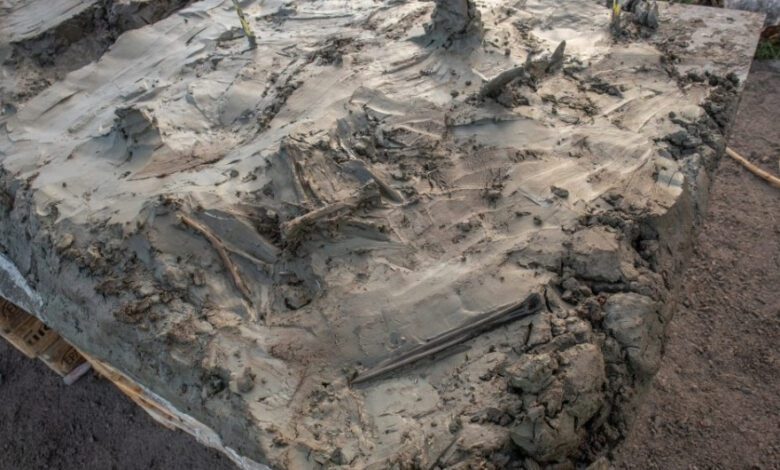
In the small town of Järna, southwest of Stockholm, archaeologists have once again drawn attention thanks to an unexpected discovery. While working in the Logsjemossen bog, experts found the remains of a large dog that had been buried in the peat for thousands of years. Next to the animal lay a dagger carved from elk or red deer bone. Experts estimate the find to be at least four thousand years old—dating back to the Neolithic era, when advanced settlements and complex rituals already existed in what is now Sweden.
The dog’s skeleton was remarkably well-preserved: based on its size and structure, scientists determined it was a male, between three and six years old. The animal’s withers measured about 52 centimeters, making it rather large for its time. Researchers were particularly intrigued by the location of the remains—at the bottom of a vanished lake, roughly 30–40 meters from the ancient shoreline. Archaeologists believe this area was once bustling with life: there are traces of fishing traps and other equipment left behind by the region’s prehistoric inhabitants.
Discovery details
While examining the skeleton, experts discovered clear signs of violent death. The dog’s skull had been smashed, which, according to researchers, indicates a deliberate killing of the animal before burial. Afterward, the body was likely wrapped in a hide or thick cloth and then sunk to the bottom of a body of water, weighed down with stones to prevent it from surfacing. This method of burial was not accidental—it suggests a special attitude toward the animal and is possibly linked to ritual practices of that era.
Beside the remains, archaeologists found a 25-centimeter dagger made from the bone of a large animal. The weapon was preserved in nearly perfect condition, allowing its structure and manufacturing technique to be studied in detail. Similar items in the Neolithic were often used not only in everyday life but also in rituals connected with sacrifices or initiations. The joint burial of the dog and dagger may point to the animal’s special role in the life of the ancient community.
Rituals and Customs
Animal burials in bogs and lakes are not uncommon in archaeology, but such cases always raise many questions. Why a dog? What role did it play in Neolithic society? Researchers suggest that these burials could have been part of complex rituals related to worship of spirits, hunting, or protection of the settlement. In some cultures, dogs were believed to be guides to the afterlife or guardians against evil forces.
In this case, according to scientists, the animal was not a random victim. Its age, physical condition, and the method of burial indicate that the dog held a special place among the people who lived on the shores of the ancient lake. It may have been a hunter’s companion or even a symbol of a particular lineage or clan. The dagger found nearby might have served not only as a weapon but also as a ritual object, underscoring the significance of the event.
Archaeological discoveries
Work at Logsjömosse continues as part of preparations for railway construction, allowing archaeologists to study the area as thoroughly as possible. Each new artifact helps reconstruct the life and customs of the people who inhabited these lands thousands of years ago. In addition to the dog and the dagger, fishing traps, remains of wooden structures, and other household items were found in the bog, all pointing to the high level of organization in this ancient society.
The ways in which ancient inhabitants interacted with their environment are of particular interest. The use of bogs and lakes for ritual purposes is seen in various parts of Europe, but such discoveries are rare in Sweden. This makes the find at Logsjömosse especially valuable for science and offers new insight into the traditions and beliefs of Neolithic communities.
Scientific significance
The discovery of such a well-preserved dog skeleton together with a ritual dagger opens up new horizons for studying not only the daily life but also the spiritual world of ancient people. DNA analysis, bone structure, and accompanying objects may provide answers to questions about the origins of domestic animals, their role in society, and the specifics of human interaction with nature in the Neolithic era.
Findings like these mark important milestones in archaeology, helping not only to expand museum collections but also to deepen our understanding of processes that took place in the distant past. Each new artifact is a step closer to unraveling the mysteries still hidden within the bogs and forests of Northern Europe.
In case you didn’t know, Arkeologerna conducts archaeological research and rescue excavations throughout Sweden. The organization is renowned for its large-scale projects related to infrastructure construction and regularly reports on new discoveries that contribute to regional historical study. Thanks to their work, many unique artifacts, including those found in Lögse mossen, are made available for scientific analysis and the general public.