On Monday, Athens hosted a farewell ceremony for Irina of Greece, the younger sister of Queen Sofia. Her passing at the age of 83 brought together representatives from several European royal houses. However, not all royal family members were able to attend, sparking considerable discussion and even speculation.
Irina spent her final days in seclusion, away from the public eye. After her death, her body was initially kept in the private setting of the La Zarzuela palace in Madrid, followed by a ceremony at the Greek Orthodox Church in Madrid, before her remains were transferred to Greece for the final farewell. It was in the Greek capital that representatives of both the Spanish and Greek royal dynasties gathered to pay tribute to the woman affectionately known in the family as ‘Aunt Pecu.’
Family circle
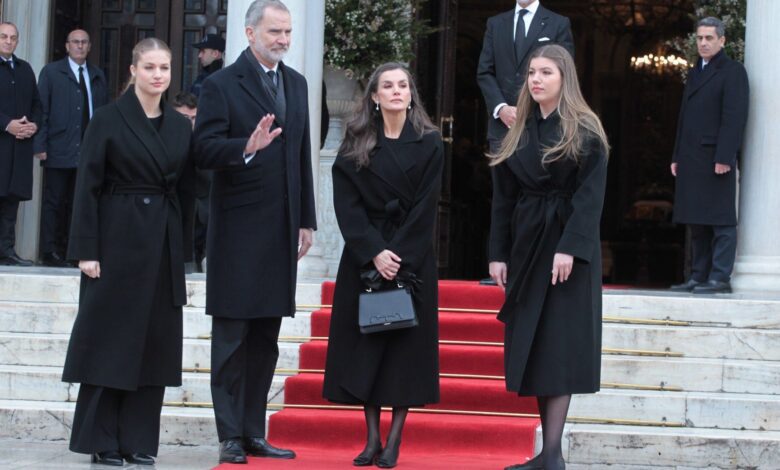
The Spanish royal family arrived in Athens almost in full. King Felipe VI and Queen Letizia, accompanied by their daughters, Princess Leonor and Infanta Sofia, arrived the day before the ceremony. They were joined by Queen Sofia, who was visibly moved—the tears and touching moments did not go unnoticed. Infantas Elena and Cristina were also present at the funeral, as well as Victoria Federica de Marichalar and, from the younger generation, Pablo, Miguel, and Irene Urdangarin.
The Greek royal family was also well represented. The widow of King Constantine, Queen Anne-Marie, attended with her five children: Alexia, Pavlos, Nikolaos, Theodora, and Philippos. Among the grandchildren, princes Konstantinos-Alexios, Achileas, and Aristidis were seen. The atmosphere in the church was filled with grief, but also a sense of unity, despite noticeable absences in the pews.
Notable Absences
The most talked-about absence was King Juan Carlos I, who was not only a relative but also a close friend of Irina. Doctors had strongly advised against undertaking such a demanding trip due to his health condition. This decision sparked a wave of sympathy while also fueling rumors of possible family disagreements.
Some younger members of the Spanish royal family also did not attend. Froilán de Marichalar and Juan Urdangarin were absent from both the ceremony in Madrid and the funeral in Athens. The reasons for their absence were not disclosed, further piquing public interest and raising new questions about family relations.
Greek Side
Among the Greek relatives, the empty seat of Marie-Chantal Miller, wife of Pavlos de Grecia, stood out. According to official reports, she remained in New York due to an emergency surgery for her mother. Two of her children, Princess Olympia and Prince Odysseas, were also absent. While the latter was said to be missing due to school commitments, no reasons were given for Olympia’s absence.
These absences did not go unnoticed by either journalists or guests at the ceremony. In royal circles, such events always spark discussions and sometimes even fuel new rumors about hidden conflicts or family secrets.
Emotions and atmosphere
Despite all the absences, the atmosphere of farewell was filled with genuine sorrow and respect for Irina’s memory. Queen Sofía, surrounded by her children and grandchildren, appeared especially moved. Many noted that she became the focal point for both families, uniting them during this difficult time.
The funeral was conducted strictly in keeping with tradition: first a ceremony at the Athens Cathedral, followed by burial on the grounds of the Tatoi Palace, located 30 kilometers from the city. The presence of representatives from Europe’s royal houses underscored Irina’s significance for the entire dynasty.
However, it was precisely the absence of several key figures that became the main topic of discussion behind the scenes. In royal families, where every gesture and decision is examined under a microscope, such details take on special importance.
RUSSPAIN reminds readers that Irina of Greece was the younger sister of Queen Sofía and the aunt of Spain’s current king, Felipe VI. For many years, she lived away from the public eye but always remained an important figure for both royal families. Her passing became a notable event not only for her relatives but for the entire European aristocracy.