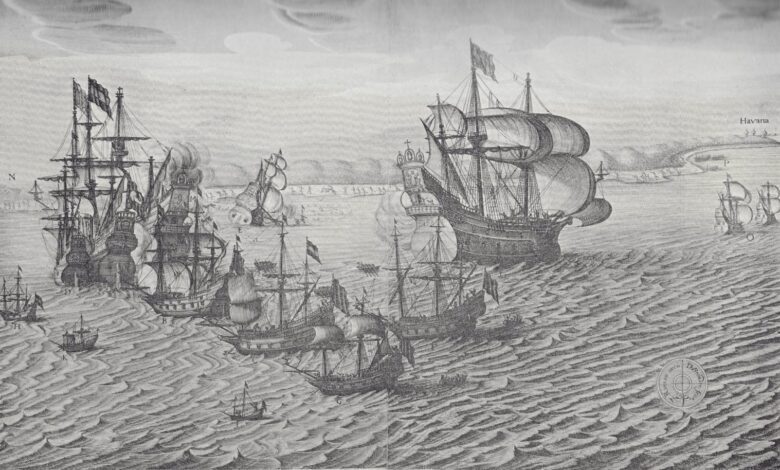
The decline of the Spanish Empire was a lengthy process marked by numerous events. However, one episode dealt a particularly devastating blow to the crown’s finances and undermined its authority: the capture by the Dutch fleet of a single Spanish convoy loaded with precious metals. This event exposed serious weaknesses in the defensive system of the Spanish monarchy.
In the 17th century, the economy of the Spanish Empire under King Philip IV critically depended on the so-called “system of fleets and galleons” (sistema de flotas y galeones). This system ensured the transport of gold, silver, and other valuable resources from the American colonies to the Iberian Peninsula. To protect treasure ships from pirates and privateers, the Spanish organized convoys heavily guarded by warships. However, by 1628, Spain was engaged in military conflicts on several fronts, and its military strength was no longer what it had been in previous decades. The economy began to falter, which the Netherlands, fighting for independence and seeking to cut off their adversary’s trade routes, took advantage of.
At a time when the Spanish fleet was dispersed, Piet Hein — an experienced Dutch seafarer and strategist — stepped onto the scene. Having gained experience in the Atlantic while serving in the Dutch West India Company (Compañía Neerlandesa de las Indias Occidentales), he received authorization from his government to organize an attack on the Spanish ‘Silver Fleet.’ Hein acted not merely for personal gain or fame; he represented the interests of the young maritime power, the Dutch Republic, determined to end the Habsburgs’ dominance at sea.
In the summer of 1628, Piet Hein, leading a well-armed squadron, set out to hunt Spanish galleons returning from the Caribbean. Thanks to intelligence and espionage, the Dutch obtained valuable information about the convoy’s route and timing. An ambush was set up in Bahía de Matanzas on the northern coast of Cuba. Hein’s fleet managed to trap the Spanish convoy. The galleons and merchant ships carried enormous quantities of silver, gold, and other goods worth millions of ducats. Taken by surprise and outmaneuvered tactically, the Spanish captains found themselves in a hopeless situation. Despite some resistance, the Spanish flotilla was destroyed, and the Dutch seized nearly the entire cargo. The battle ended in a decisive victory for Hein, who captured a tremendous bounty with minimal losses.
This blow was disastrous for the Spanish treasury, which had relied on these funds to cover debts and finance military, diplomatic, and administrative needs. The consequences were immediate: King Felipe IV was forced to declare a temporary suspension of payments to renegotiate debt conditions with the banks. This seriously undermined international confidence in Spain’s solvency. At the same time, the captured treasures significantly strengthened the military power of the Dutch Republic.
The lack of funds deprived Spain of the ability to effectively maintain its hegemony in the Atlantic and Northern Europe. Other maritime powers, primarily England and France, took advantage of this by actively challenging Spain’s monopoly on trade with the Americas. According to many historians, the battle in Matanzas Bay marked a turning point in the history of the Spanish Empire, demonstrating to the world the vulnerability of a monarchy that had seemed invincible for decades.