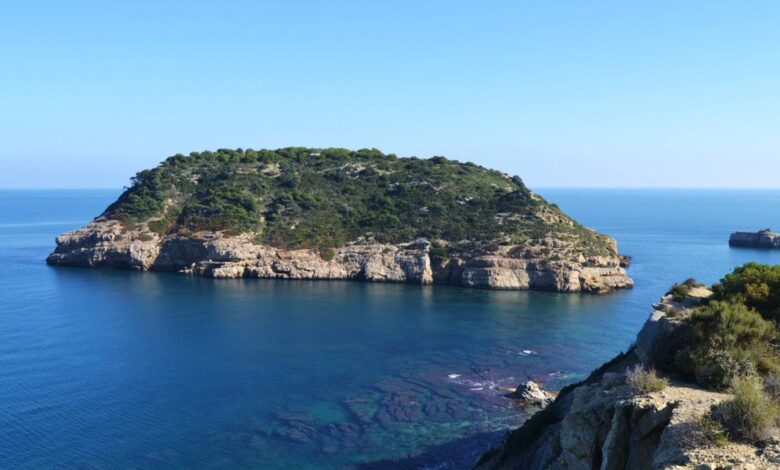
The coast of Alicante, famous for its lively resorts and endless beaches, still hides corners where time seems to stand still. Just opposite the rocky cliffs of the Marina Alta region, a small island rises from the azure waters of the Mediterranean Sea. It stands like a silent guardian, preserving traces of long-lost civilizations and providing a safe haven for rare species that have survived the relentless advance of the tourism industry. Its distinct rounded contours and deliberately limited access have helped preserve this spot in almost pristine condition. It’s no surprise that it has been designated as a Site of Cultural Interest and placed under strict protection as a priceless ecological enclave.
Treasures Above and Below the Water
This patch of land, just over eight hectares in size and with a maximum height of 75 meters, is known as Isla del Portichol and is located a few hundred meters off the coast of Xàbia. It is completely uninhabited, with a rocky, steep, and hard-to-reach terrain. But its main secrets are hidden from view. Beneath its stony surface and in the crystal-clear surrounding waters lies one of the most important archaeological complexes on the entire Alicante coast. Years of research have uncovered remnants of Roman structures, numerous fragments of ancient ceramics, and even tombs dating back to the Byzantine period. This proves that the island was inhabited or at least actively used for many centuries.
The largest anchor cemetery in the Mediterranean
The seabed around the island has proven to be a true time capsule, preserving centuries of maritime history. Archaeologists working here have found that this sheltered bay has served as a safe anchorage since the Phoenician era, and during the height of the mighty Roman Empire, it became a key trading hub on busy sea routes. The most astonishing discovery is more than two hundred anchors of various ages and designs, making this area the largest known concentration of such artifacts anywhere in the Mediterranean. In addition, the remains of two shipwrecks were found on the seabed: one Punic vessel dating back to around the 8th century BC, and another that sank in the 18th century. Each of these finds is a priceless source of information about ancient routes and trade links.
A private reserve under legal protection
Since the mid-20th century, the island has been privately owned by the Guillermo Pons family, with Guillermo Pons himself considered one of the pioneers of the environmental movement in Spain. He was a strong advocate for preserving this unique natural area, and today his noble cause is carried on by his descendants. The local authorities of Xàbia, for their part, have long imposed a complete ban on any construction on the island, effectively securing its untouchable conservation status. Thanks to these joint efforts, the island has become an open-air botanical garden, serving as a sanctuary for native plant species. Here, pine groves and dense Mediterranean scrub flourish, while crystal-clear waters lap at vast meadows of oceanic Posidonia, a plant vital to the marine ecosystem.
Reaching the island itself is no easy feat: access is strictly limited, and you can only get there by boat or kayak from the nearby Portitxol bay, famous for its whitewashed fishermen’s cottages with bright blue doors. For diving enthusiasts, there’s a special underwater trail that lets visitors see ancient anchors and other archaeological finds firsthand. Above the surface, the island impresses with its fossil cliffs and natural caves shaped by thousands of years of erosion. Its remarkable state of preservation and rich history make it a model of how environmental protection and heritage conservation can go hand in hand. Research on the island is ongoing, and scientists plan to create a virtual museum to make these unique discoveries accessible to everyone.