Spain is filled with architectural treasures, many of which are closely linked to its rich religious history. Scattered across the country are Romanesque, Gothic, and Baroque churches, standing as reminders of the pilgrims and communities who built them centuries ago. Some remain an integral part of daily life in their towns, while others have become true gems that attract travelers from around the world.
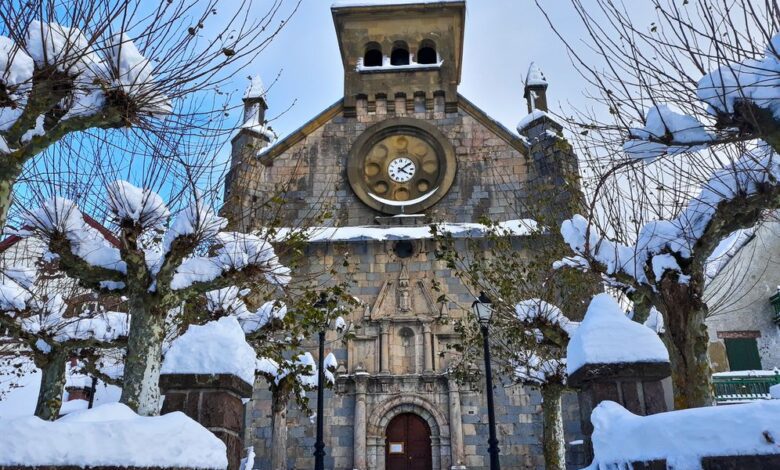
Amid the abundance of historic buildings, one medieval church stands out for having survived fires, countless reconstructions, and the test of time itself. Its history dates back to the 12th century, and despite all the challenges, it remains a remarkable blend of history and architecture, continually drawing the attention of those traveling along the Camino de Santiago. This is the church of San Nicolás de Bari, located in Burguete, in the autonomous community of Navarra.
This small Navarrese municipality, intertwined with centuries of pilgrimage, is located on one of the most legendary routes—the Camino Francés. Standing right on its main street is a church that not only serves as the town’s sole parish but is also a key site for understanding the region’s spiritual and cultural history. Its proximity to the Colegiata de Roncesvalles and its role as a transit point made this church a landmark as far back as the Middle Ages. The significance of the San Nicolás de Bari church has not gone unnoticed by UNESCO, which included it among the sites linked to the Camino de Santiago and designated as World Heritage. This recognition is no coincidence: the church bears centuries of devotion, traces of reconstructions, and unique architectural details. While its current appearance is the result of the most recent major restoration, carried out between 1945 and 1968, the first references to the church date back to 1104, underscoring its deep historical legacy.
Over the centuries, the church has survived several devastating fires, requiring it to be rebuilt multiple times. Yet, even amid these losses, some elements were saved, and today they add to the building’s unique charm. Among them are two pointed windows from the old medieval church, as well as remnants of brackets and 16th-century ribbed vaults. The most impressive feature is the monumental Baroque portal from 1699, funded by the Oros family. Their coat of arms still adorns the main entrance, and later became the official emblem of the city.
The church’s recent history is also marked by touching events. After the fire in 1861, the collegiate church of Roncesvalles donated a 17th-century bell dedicated to Saint Mary, which still hangs in the tower today. This is yet another symbol of the close ties between the two religious institutions and the important role the church has played as a spiritual refuge on the Camino.
The church’s interior features a restrained yet richly detailed design. The building has a single nave divided into three sections, a transept of equal height, and a straight apse. The ribbed vaults and lunettes give the space a sense of dynamism, capped by an elevated choir and a modern sacristy accessible from the transept. The Baroque main altar, relocated from the former parish of Santa Engracia de Sarriguren, brings a necessary artistic touch to the ensemble.
Today, the church of San Nicolás de Bari remains a place of tranquility for pilgrims, a living fragment of Navarre’s medieval history, and a must-see for those who love discovering corners that have withstood the passage of centuries.
By the way, the Way of Saint James, or Camino de Santiago, is a network of pilgrimage routes leading to the reputed tomb of the apostle James in Santiago de Compostela, Galicia. It is one of the most renowned Christian pilgrimage routes, alongside those to Rome and Jerusalem. Each year, hundreds of thousands of people from around the world make the journey. In 1993, the Spanish and French sections of the route were listed as a UNESCO World Heritage Site for their unique cultural and spiritual significance.