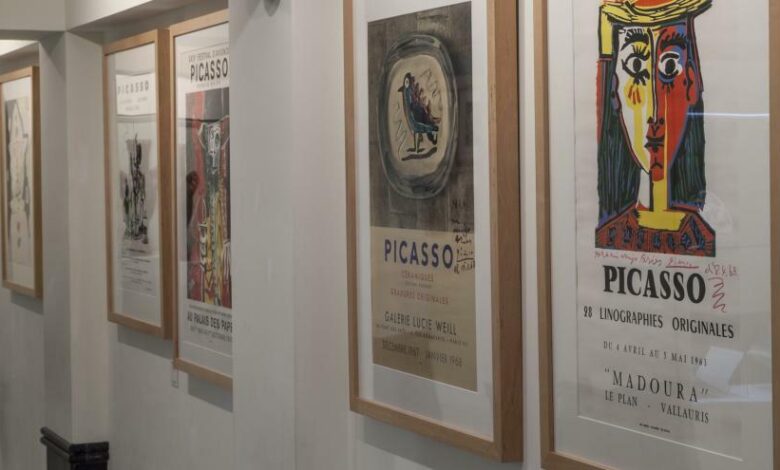
Buitrago del Lozoya, a small town in the northern mountains of Madrid, draws travelers mainly for its medieval walls and imposing castle. Yet behind this historic façade, beneath the arcades of the town hall, lies a treasure that few people know about. Here, far from the bustle of major cities, is one of the most personal and touching museums dedicated to Pablo Picasso. It is not just a gallery, but a tangible testament to the remarkable friendship that bound the 20th-century genius to his barber, Eugenio Arias.
Their paths crossed in Toulouse in 1945 thanks to Dolores Ibárruri, the famous ‘Pasionaria.’ That encounter marked the beginning of a years-long relationship that grew stronger in the French town of Vallauris. There, Arias ran his barbershop, which became a haven for Picasso. During haircuts and shaves, the two Spaniards—exiles in a foreign land—would have long conversations about their homeland, politics, and bullfighting. It was in this climate of trust and understanding that a collection began to take shape, destined to return to Spain, to Arias’s home village.
For more than twenty years, the artist gifted his friend drawings, ceramics, lithographs, and even personal belongings. Each item was marked with a dedication, a warm message, or a shared memory. There was no place for commerce in this relationship; everything was built on genuine affection and deep respect. Picasso’s gifts were more than works of art—they were chapters in the chronicle of their friendship. They tell the story of two compatriots, united by homesickness and shared ideals, humanizing the great master and honoring his loyal companion.
In 1982, Eugenio Arias decided to donate all the treasures he had collected to his hometown. Thus, in 1985, the Museo Picasso – Collection Eugenio Arias opened its doors, becoming the first museum inaugurated under the patronage of the Community of Madrid. The exhibition impresses with its diversity and intimacy. Among the exhibits are shaving basins painted with scenes from Don Quixote and bullfighting motifs, a portrait of Arias’s mother, and a unique wooden box adorned with pyrography. It is said that an Arab sheikh once offered a blank check for it, but was turned down.
The collection also reflects the artist’s political views. It includes posters with the famous dove of peace and works dedicated to the amnesty of political prisoners in Spain. There are also examples of his tireless experimentation. For instance, an unusual piece called “cagafierro” (literally “iron pooper”), created by Picasso in the 1960s, shows how the genius could turn even the most prosaic material into a work of art. Every piece in this small museum offers a window into the artist’s inner world, his thoughts and emotions.
For Arias himself, founding the museum in Buitrago was an act of restoring justice and preserving memory. He saw it as a duty, both to his homeland and to his great friend. Today, the museum, located on Picasso Square, stands as a living testament to this heartfelt friendship. It is a must-see for anyone exploring the northern part of the Madrid region. Admission is free, making it even more appealing to tourists coming to admire the historical heritage of Buitrago del Lozoya.