The source of a river is always shrouded in a special kind of magic. It’s not just a geographic point on the map, but a true place of power, where life emerges from underground to embark on a long journey toward the sea. Spain, with its diverse landscapes, is home to several hidden corners like this—perfect for leisurely walks and connecting with nature. In summer, these spots still offer cool relief, and as autumn approaches, the scenery transforms with breathtaking colors, making them a wonderful travel destination. We invite you to discover three iconic places where the main rivers of Galicia, the north, and Andalucía begin their journey.
The journey begins in the northwest, in Lugo, where Pedregal de Irimia lies hidden in the heart of the Sierra de Meira mountain range. This place amazes visitors at first sight. Instead of a familiar spring, you see a gigantic stone river formed of quartzite boulders, cascading down the mountainside and creating a funnel about 700 meters long. It’s as if the earth itself has bristled, shaping this harsh landscape. Beneath this rocky surface runs a small stream that marks the origin of the Miño, the longest river in Galicia. The site is also of scientific value—preserving traces of the ancient glacier that existed here 10–20 thousand years ago. But the local legends are even more fascinating. One tells of the witch Irimia, who, angered by the monks, cursed the spring by covering it with rocks so that no one could drink its water. Today, the area is equipped for tourists and makes for a perfect hiking destination to experience the full power of Galicia’s nature.
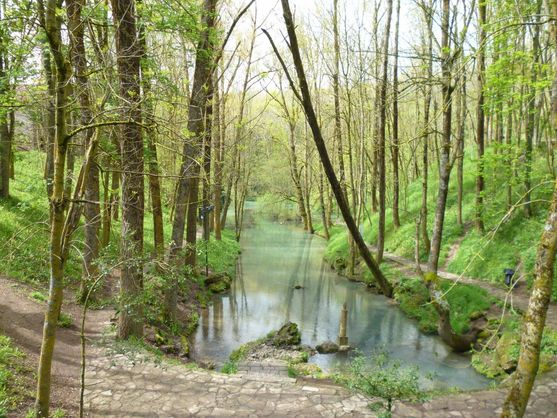
Next, our journey takes us to Cantabria, to the small village of Fontibre. Its name, derived from the Latin ‘Fontes Iberis,’ directly highlights its significance—’the source of the Ebro.’ Here, in the spot known as Fuenteona, amid ash and poplar trees, Spain’s most voluminous river officially begins its course. At the spring, a monolith features the image of the Virgen del Pilar, the patroness of Spain. Although geological studies in 1987 established that the scientific headwaters are further up, at Pico Tres Mares, it is Fontibre that remains, in public consciousness and local tradition, the birthplace of the great river. From here, the Ebro must cover more than 930 kilometers, crossing La Rioja, Aragón, and Cataluña before emptying into the Mediterranean and forming its famous delta. The surroundings of Fontibre and the entire Campoo region offer visitors numerous trails, waterfalls, and villages with a rich medieval heritage, making a trip here both diverse and rewarding.
Our journey ends in the south, in the very heart of the Sierras de Cazorla, Segura y Las Villas Natural Park in the province of Jaén. Here, in the Cañada de las Fuentes gorge, the Guadalquivir River is born—the great river of Andalusia. The landscape changes dramatically: instead of the green meadows of the north, we are now surrounded by pine forests and striking rock formations. This area is set up as a recreation zone, and it’s not uncommon to see deer and fallow deer coming to the water’s edge. Beneath a memorial plaque bearing verses by the Álvarez Quintero brothers lies the “official” source, although the river is actually formed from the confluence of several streams flowing into the valley. Navigable for much of its course, the Guadalquivir has played a key role in the region’s history. Its waters have seen Roman galleys and the caravels that set off from Sevilla to conquer the New World. Walking along the trails near its source is like touching the very history of Andalusia.