Valve has captured gamers’ attention once again by announcing the return of the Steam Machine—a compact gaming PC that now boasts a completely new design and modern internals. After several years of silence, the company has decided to revive the project, inspired by the success of the portable Steam Deck. The new version of the Steam Machine runs on SteamOS and is designed to deliver 4K gaming at 60 frames per second, made possible by the latest AMD hardware platform.
The Steam Machine was first introduced back in 2013, when Valve unveiled mini-PC prototypes alongside its own SteamOS operating system. Around half a million units were sold over two years, but the project was soon discontinued. Now, a decade later, the company is revisiting the idea of a desktop gaming PC, focusing on compactness, performance, and user convenience.
Technical specifications and design features
Inside the new Steam Machine is an AMD processor based on the Zen 4 architecture, capable of reaching speeds up to 4.8 GHz. The graphics are handled by a custom AMD RDNA-based chip running at 2.45 GHz. Its GPU performance is comparable to a mobile Radeon RX 7600M, allowing modern games to run at 4K resolution using upscaling technologies like FSR.
The device comes with 16 GB of DDR5 SO-DIMM RAM, and storage options include a 512 GB or 2 TB M.2 2230 SSD. Storage can be expanded if needed with SDXC-compatible microSD cards. This flexible approach makes the Steam Machine suitable for a variety of uses—from gaming to multimedia tasks.
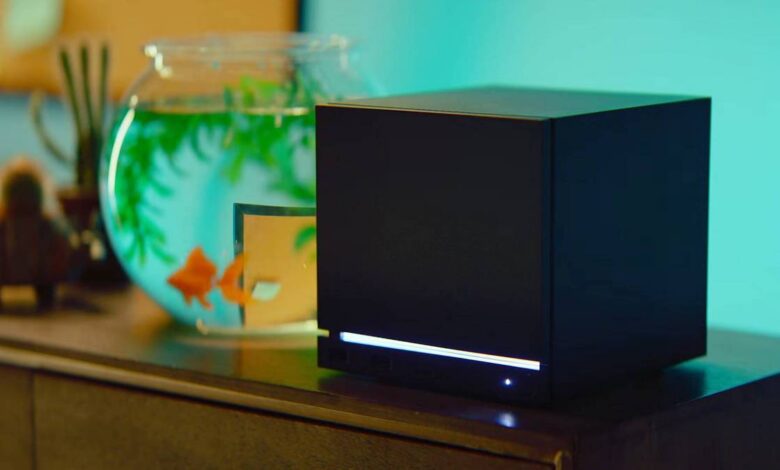
The Steam Machine design has undergone significant changes. It is now a black cube that easily fits on a 15 cm-wide shelf. Engineers focused especially on heat dissipation and acoustics: the power supply is located at the bottom of the case and also serves as the chassis, simplifying the construction and enhancing electromagnetic shielding. The motherboard sits above the power supply and is cooled by a massive heatsink, which simultaneously serves the processor, graphics chip, and memory. At the back, there is a single custom-made 120-millimeter fan.
Interfaces, customization, and additional features
The Steam Machine is equipped with four antennas for stable Wi-Fi and Bluetooth, supporting up to four controllers at once. The device’s front panel is easily removable, making it simple to clean and allowing users to change the PC’s appearance. Valve’s office is already testing various panel options: with wood textures, Team Fortress 2-themed designs, and even e-ink panels that display performance information.
Above the front panel is a customizable light strip. It signals game loading, system notifications, and other events—or can be completely turned off if desired. This approach highlights attention to detail and a focus on users’ individual preferences.
The input and output ports are located on the sides of the case, providing quick access to essential connectors. This design makes the device convenient to place in tight spaces, such as on a shelf under a TV or in a gaming area.
Global Release and Future Plans
Valve plans to launch sales of the Steam Machine in 2026. At launch, the device will be available in the USA, Canada, UK, Germany, France, Australia, Japan, South Korea, Hong Kong, and Taiwan. The price is still under wraps, but company representatives emphasize that the main goal is to make a high-performance gaming PC accessible to a broad audience.
According to engineers, the new Steam Machine is six times faster than the Steam Deck, though it still lags behind top-tier gaming PCs in terms of power. However, optimizations in SteamOS and modern upscaling technologies allow for impressive results even on compact hardware. Journalists who tested the prototype noted that Cyberpunk 2077 ran at a stable 4K60, albeit with some compromises in graphics quality.
Alongside the mini PC, Valve is preparing to release the Steam Frame virtual reality headset and an updated Steam Controller gamepad. All three devices are set to go on sale early next year, expanding the company’s ecosystem and offering new opportunities for gamers.
Valve is one of the most influential companies in the gaming industry, founded in 1996 by Gabe Newell. Valve created Steam, which has become the world’s largest digital storefront for PC games. The company is also known for iconic franchises such as Half-Life, Portal, and Dota 2. In recent years, Valve has been actively developing its own hardware, including the Steam Deck and virtual reality devices, striving to make gaming more accessible and convenient for millions of users worldwide.