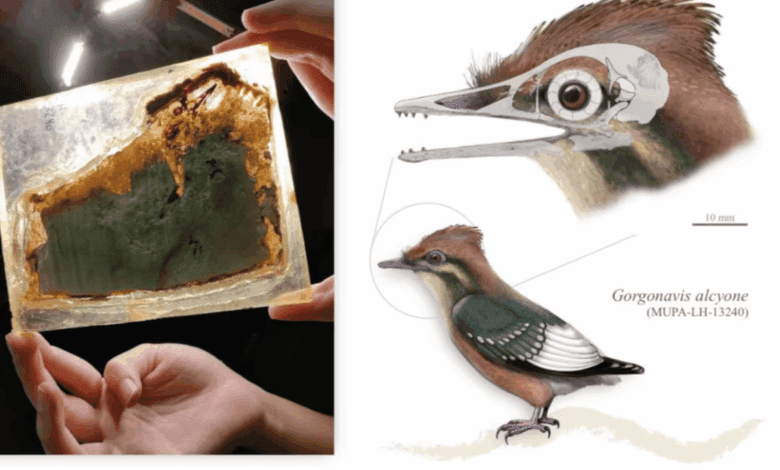
An unexpected discovery in the province of Cuenca could change our understanding of the history of life on the Iberian Peninsula. In Las Hoyas, scientists have found the remains of an ancient bird with a long beak studded with teeth. This find not only expands our knowledge of the region’s past, but also highlights the importance of Spanish paleontological excavations for global science.
The showcases of the Museo Paleontológico de Castilla-La Mancha (MUPA) now feature the skull of Gorgonavis alcyone — a new bird species that lived 125 million years ago. According to El Pais, this specimen is the first adult skull of such a bird discovered in Europe. Its size is striking: the length is just a few centimeters, and the structure is reminiscent of modern kingfishers. However, its main distinguishing feature is an elongated beak with teeth, something extremely rare among ancient birds.
A rare discovery
The study of the remains lasted two years. Specialists from the Los Angeles museum, as well as the universities of Cambridge, Malaga, and Madrid, participated in the research. Modern methods such as computed tomography and 3D modeling were used to reconstruct the skull. Thanks to these technologies, it was possible to restore details that could not be studied by conventional means.
Gorgonavis alcyone belongs to the Longipterygidae group—a lineage of birds with elongated faces previously known only from fossils found in China. Now, it’s clear their range was much broader. According to scientists, this bird lived in ancient wetlands, feeding on small animals such as insects, fish, and crustaceans. Its most distinctive trait is an unusually long, toothy beak, which sets it apart from other enantiornithines—a group of ancient birds noted for having claws on their wings.
Scientific significance
Las Hoyas covers a small area of about eight hectares, yet its scientific importance is immense. Other unique species have previously been discovered here, including Iberomesornis and the famous Concavenator corcovatus, known as the ‘hunchback hunter.’ The latter has become a symbol of the museum, drawing thousands of visitors each year. Now, a new exhibit joins the collection, already sparking interest among specialists and the general public.
Researchers say the discovery of Gorgonavis alcyone shows that ancient birds with toothed beaks were present not only in Asia but also in Europe. This alters our understanding of migration and the evolution of birds during the Cretaceous period. In addition, the find highlights the importance of Spanish geological sites in studying the history of life on Earth.
Regional impact
The Castilla-La Mancha Paleontology Museum, which opened in 2015, has already broken attendance records—visitor numbers have surpassed 700,000. According to regional authorities, the new discovery is expected to attract even more tourists and researchers. Each new exhibit strengthens Cuenca’s reputation as one of the world’s leading paleontological centers.
In recent years, Spain has regularly been the site of sensational discoveries. For example, in nearby areas, rare dinosaurs and ancient mammals have been unearthed, confirming the uniqueness of the local geological conditions. Such discoveries not only enrich scientific collections but also contribute to the growth of tourism and education in the region.
Paleontological discoveries in Spain have repeatedly been the subject of discussion within the scientific community in recent years. In 2024, a new dinosaur species was found in the province of Aragón, and rare remains of ancient mammals were discovered in Catalonia. Each of these cases emphasizes that the Iberian Peninsula remains one of the most important regions for studying the evolution of life on Earth. Thanks to these finds, Spain is solidifying its position in global science and continues to impress with new discoveries.