In the heart of Alicante province, at the site of the former Albatera concentration camp, archaeologists have uncovered unexpected relics of the past. What began as an ordinary conversation with a local resident turned into a real sensation: he recalled that in the 1950s, a whole mountain of empty tin cans lay abandoned on a plot of land. For researchers, this was far more than just rubbish—it proved to be a true treasure trove, shedding light after decades on the fate of the camp’s prisoners.
The most recent archaeological expedition, held in November, brought remarkable discoveries. Among the rusty cans and everyday objects, a military button featuring the American eagle was found, as well as coins from the Netherlands, Switzerland, and the Soviet Union. These items serve as direct evidence that International Brigades—foreigners who fought for the Republic—were among the camp’s inmates.
Prisoners’ Testimonies
For archaeologists, such discoveries were not entirely unexpected. In the memoirs of former prisoners, published back in the 1990s, there are repeated mentions of foreigners who found themselves in Albatera. One inmate, José Bonet, wrote about how some foreigners were deceptively led out of the camp grounds, allegedly for deportation, but were, in fact, executed by firing squad. These tragic episodes remained only words for a long time—until the earth began to reveal its secrets.
Another former prisoner, Miguel Siñes, recalled how the guards would take cans out of the camp, stacking them by a ditch under the palm trees. For archaeologists, this became a kind of treasure map, as years later unique artifacts were found in that very spot. A button featuring the American eagle, typical of 1930s military uniforms, became the key clue: the camp had indeed held members of the International Brigades, including volunteers from the United States.
History of the Camp
The Albatera camp was established on the site of a Republican labor camp and, starting in April 1939, became one of the largest concentration camps in Francoist Spain. Over the course of seven months, around 15,000 people were detained there. Many had been captured at the port of Alicante as they tried to flee the country after the fall of the Republic. The prisoners included not only Spaniards, but also foreigners—members of the International Brigades—as well as elite units of the Republican army.
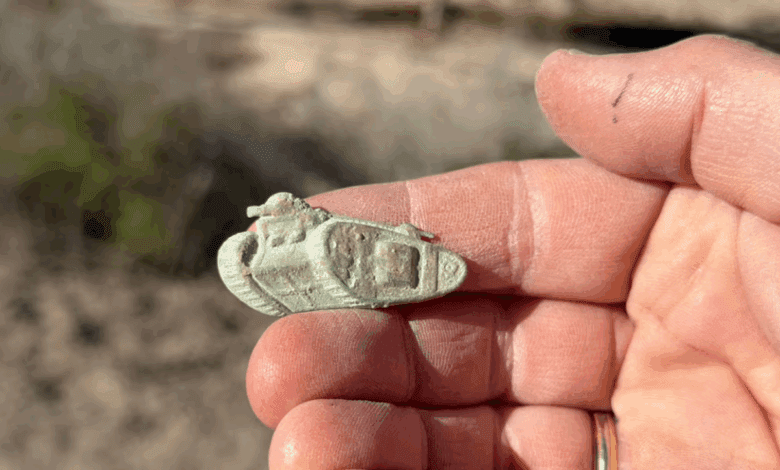
In 2025, archaeologists returned to the camp grounds, having secured funding to search for and exhume graves dating back to the Civil War. Local authorities supported the project, and the municipality of San Isidro, where the camp is now located, took an active role in the excavations. During the work, they found not only foreign coins but also military insignia: a copper tanker’s emblem depicting a British World War I tank and badges belonging to pilots of the Republican Air Force.
Coins and Artifacts
The discovery of coins sparked particular interest. In addition to French and Moroccan ones, this time archaeologists unearthed a Dutch silver florin from 1923, a Swiss five-franc coin from 1908, and Soviet three-kopeck pieces from the 1920s. These finds leave no doubt: among the prisoners were people from different countries who fought for Spain’s freedom. Along with an American button, they serve as silent witnesses to the international makeup of the camp’s inmates.
The camp held not only military personnel but also civilians. Many ended up here after a failed attempt to evacuate from Alicante to Algeria. Among them were women who played a special role in camp life. They came from afar — from Murcia, from Alicante itself, walking dozens of kilometers on foot to support their loved ones. Women brought food, spoke with prisoners through the fence, and sometimes even bribed guards to pass along packages.
A Woman’s Mark
Excavations also uncovered unexpected traces of women’s presence. Among the discarded items, archaeologists found lead discs — weights that were sewn into skirt hems to keep them from blowing up in the wind. Other items were also discovered: shawl brooches, hairpins. All these finds indicate that women not only supported the prisoners but also left their imprint on the camp’s history.
Amidst the usual finds—cartridges, buckles, trade seals—there were also rarer items that offer a new perspective on life in the camp. Each artifact is a piece of the larger mosaic that forms a tragic, yet essential picture for understanding Spain’s past.