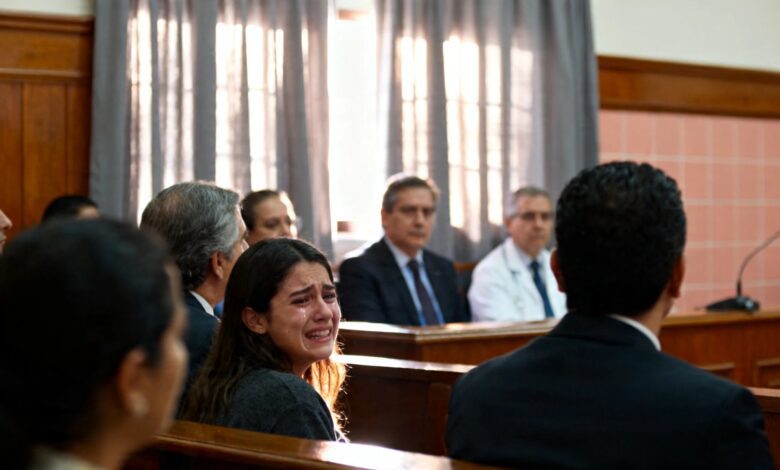
The second court trial has begun in Argentina to clarify the circumstances of Diego Maradona’s death. The hearings are held in a small courtroom in San Isidro, where the focus is on the doctors responsible for the legendary footballer’s treatment. Maradona’s family is convinced that the medical staff did nothing to prevent the tragedy. The central question in this case is whether Maradona could have lived to see his 66th birthday.
Scandal surrounding the first trial
The first trial was annulled when it emerged that one of the judges, Julieta McIntach, had secretly filmed a documentary titled “Justicia divina” with the subtitle “La jueza detrás de D10s.” After dozens of hearings and interrogations, the process had to be restarted. The judge’s career ended, and her actions became the subject of a separate investigation. However, for Argentinians and football fans worldwide, the main issue is to find out whether Maradona could have been saved.
The Accusations and the Defense
Prosecutor Patricio Ferrari claims that all the defendants abandoned Maradona to his fate, which led to his death. According to him, the footballer suffered from swelling all over his body and had three liters of fluid, and 12 hours before his death, he could have been saved if he had been hospitalized in time. At the center of attention is psychiatrist Agustina Cosachov, who is even accused of falsifying medical records. She is taking the charges hard, unlike neurosurgeon Leopoldo Luque, who publicly proclaims his innocence and remains calm under pressure.
The Maradona family’s lawyers describe the doctors’ actions not just as negligence, but as deliberate indifference. Psychologist Carlos Diaz, who worked with Maradona, does not hide his emotions and struggles to hold back tears. The defense, however, insists that Maradona was a difficult patient who did not follow recommendations and sometimes even showed aggression toward the doctors. According to their version, he was able to make his own decisions despite his dependency.
Family conflict and new details
Particular tension was caused by a defense lawyer’s statement that Maradona alone was responsible for his own health. This prompted a sharp reaction from Jana Maradona, the footballer’s daughter, who was present in the courtroom. Her reaction was noticeable to everyone in attendance. At the next hearing, Luque unexpectedly spoke, attempting to convince the judges of his dedication to the patient. However, on the same day, audio recordings were released in which Luque discusses with assistant Maximiliano Pomargo the details of Maradona’s care and admits he does not intend to visit the patient daily, despite promises made to the family.
The Maradona family opposed home hospitalization, which was actively supported by Luque and Pomargo. In their view, this allowed control over both access to the patient and financial flows. In the audio recordings, Luque promises Maradona’s daughter, Gianinna, that he will be responsible, but privately admits the opposite.
Context and societal significance
This case has become one of the most talked-about in Argentina in recent years. Questions about medical liability, patient rights, and medical ethics go far beyond a single family. Similar conflicts over the care of public figures have repeatedly drawn public attention, as was the case with debunking rumors about a crisis in the family of Ingrid Betancourt and Ibaï Gomez— the details of this conflict also sparked widespread public reaction. The Maradona case could last several months, and its outcome may impact the approach to medical responsibility in Argentina.