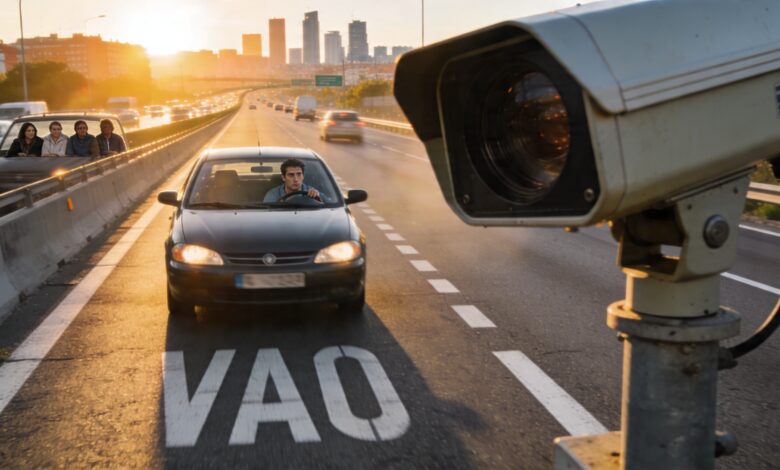
New rules for high-occupancy vehicle (VAO) lanes have come into force in Spain: now, drivers traveling alone risk an automatic fine of 200 euros for using them. The first cameras detecting the number of passengers in a vehicle are already operating on the A-2 highway in Madrid and on the approach to Seville. According to the DGT, the system will be expanded to other regions of the country by the end of 2026.
Fines and new cameras
The control system no longer depends on road inspectors: modern cameras and radars can determine the number of people in a car without stopping the vehicle. Violations are recorded around the clock, and fines are issued automatically. Drivers who ignore the new road signs and enter the VAO lane alone will receive a penalty notice without warning.
Special attention is given to those accustomed to the benefits for electric vehicles: now, even zero-emission cars are banned from these lanes if there is only one person in the vehicle. The new rules revoke previous VAO privileges for electric car owners.
Where restrictions are already in effect
At the moment, cameras are installed in two key areas: on the A-2 highway in Madrid and on the approach to Seville via Mairena del Aljarafe and the SE-30 road. In these zones, all vehicles entering the VAO lane are automatically monitored by video surveillance. If there are fewer than two people in the car, the system detects the violation and initiates the penalty procedure.
According to DGT, similar measures are planned for the central section of the A-6 in Madrid, on the roads of Granada (GR-3211), on the bridge between Seville and Camas, on several sections in Malaga, on the Ma-19 in Palma, on the left lanes of the A-2 between Torrejón de Ardoz and Madrid, as well as on the V-21 in Valencia. All these sections will be equipped with modern cameras and radars to monitor the number of passengers.
Changes for drivers
The introduction of automatic fines is linked to DGT’s policy to reduce the number of cars on the roads of major cities. According to the head of the department, if each car carried at least two people, this would cut traffic, fuel consumption, and emissions in half. The new rules are designed to promote carpooling and ease the burden on urban infrastructure.
Drivers are advised to pay close attention to road signs and not rely on previous exemptions for electric vehicles. Violations are recorded without the involvement of the Civil Guard; the cameras operate 24 hours a day. DGT warns: fines will be issued not only for driving alone, but also for entering or exiting the VAO lane at unauthorized points.
Context and prospects
The expansion of the automatic control system on VAO lanes is part of a large-scale road traffic reform in Spain. By the end of 2026, all key sections where high-occupancy lanes are being introduced are scheduled to be equipped with new cameras. This decision has already sparked discussion among motorists, especially in Madrid and Andalusia, where the new measures affect thousands of drivers daily.
Issues of transport infrastructure and road monitoring are becoming increasingly relevant for major Spanish cities. Just as in the struggle for key positions in sports—where every detail counts—new measures by the DGT could significantly alter the usual pace of getting around urban centers. Speaking of sports battles: a decisive match for promotion to Segunda was recently held in Castellón, more details of which can be found in the article about the struggle between Castellón and Burgos for crucial points.