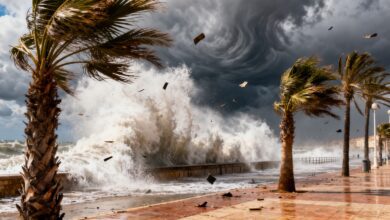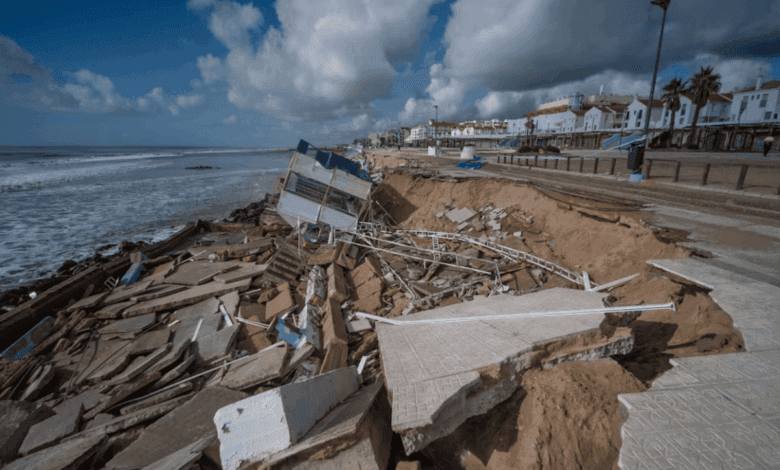
A powerful storm that struck the Matalascañas coastline in Huelva province has literally wiped out a kilometer and a half of the promenade. The waves spared neither the pavement nor the buildings that stood right at the water’s edge. Now that the storm has subsided, not only ruins remain in the spotlight, but also an intense conflict between local and central authorities. Uncertainty looms over whether the infrastructure can be restored by summer, leaving thousands of tourists and business owners anxiously waiting.
The problem extends far beyond the resort’s appearance. Two families have been forced to leave their homes, and another fifty residences sustained damage. The city administration is calling for urgent measures to bring tourists back and save the season. However, the Ministry for Ecological Transition is demanding a comprehensive, long-term strategy to protect the coast from further disasters. As a result, instead of a unified plan, both sides are trading accusations and blaming each other for inaction.
Tourism at risk
Summer is when Matalascañas comes alive, with up to 150,000 vacationers flocking to its beaches. Now, the prospect of welcoming guests to the familiar promenade seems increasingly uncertain. Restoring the one and a half kilometers of destroyed boardwalk and access points to the sea will take much longer than just a few months. The municipality admits it will not be possible to make everything perfect by the season; at best, they can bring the area to an acceptable state.
The economic losses are already being felt. Four beach bars have disappeared along with the sand, and hotel and apartment owners are reporting a sharp decline in bookings. City officials estimate the total damage at 10 million euros and are demanding the area be declared a disaster zone to secure extra funding. But while officials argue, locals and business owners are taking to the streets with signs reading “Matalascañas se hunde, SOS,” demanding immediate action.
Долгие обещания
The ministry insists: the problem is not just the storm, but global climate change, which is making the coast increasingly vulnerable. The agency proposes a complete overhaul of coastal protection, possibly even moving the promenade further inland. But this would require not just time, but also the municipality’s consent to transfer land. What’s more, the idea of large-scale expropriation of beachfront homes and villas was even discussed, sparking outrage among residents. However, these plans are already being abandoned, as officials acknowledge their unrealistic nature and the enormous cost—up to 600 million euros.
Francisco Bella, the city’s mayor, does not hide his frustration: according to him, the ministry has been dragging its feet for years, and real work to reinforce the beach began only a week before the devastating storm. As a result, when the sea became rough again, the machinery had to stop, and restoration efforts resumed only recently. Bella also blames the old breakwaters at the river mouth and in Mazagón, which, in his opinion, have blocked the natural flow of sand and worsened beach erosion.
People on the Brink
While officials argue, residents and business owners are left watching as excavators move sand back and forth, with land in some areas literally hanging in midair. The Pueblo Andaluz district and the Alcotán building have been especially affected, with military from a special emergency unit brought in to ensure safety. People worry that the next storm, which meteorologists predict as soon as next week, could finally destroy the surviving homes.
In this situation, fear and frustration are growing by the day. Many are asking: why, after six years since the previous studies and recommendations to reinforce the beach, have the necessary measures still not been implemented? There’s no answer. And the sea seems only to be gaining strength, unwilling to give up even a meter of land.
No Compromise
The Ministry continues to insist on the need for long-term projects that would make the coast more resilient to natural disasters. The municipality, for its part, demands swift and concrete action to save at least part of the season and prevent an economic collapse. As a result, instead of working together, both sides are increasingly mired in bureaucratic disputes and blame-shifting.
Meanwhile, excavators are still at work on the beach, as residents and tourists anxiously watch the horizon, bracing for new storms. The future of Matalascañas remains uncertain, and hopes for a swift recovery are fading with each passing day. This coastline, once considered one of the most attractive in Andalusia, has become hostage not only to natural disasters but also to protracted political disagreements.