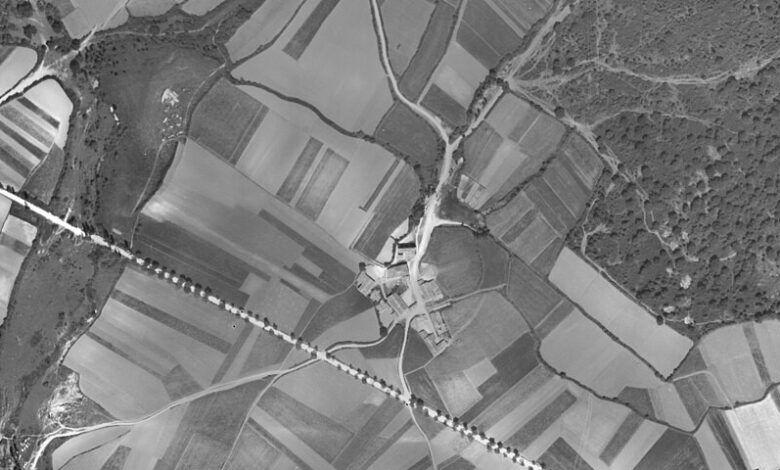
The construction of Foronda Airport in the late 1970s completely changed the fate of an entire town in Álava. Otaza, once an ordinary village with centuries of history, vanished in just a few days. Where houses and a church once stood, there are now only fields, and memories of life here survive only in archives and museum exhibits. The decision to demolish the settlement was made because of its dangerous proximity to the runway of the new Vitoria-Gasteiz airport. Authorities did not seek compromises: in November 1979, heavy machinery razed all the buildings, and by February 1980 the airport welcomed its first flights.
Otaza’s fate is not unique in northern Spain. The region has many villages that disappeared due to large-scale infrastructure projects or the mass departure of residents. However, this particular story gained an unexpected twist: just months after the demolition, a unique treasure was discovered here.
An archaeological sensation
In the spring of 1980, a family walking through the ruins of the former village stumbled upon a broken ceramic vessel. Inside were thousands of ancient coins. The find immediately attracted the attention of archaeologists, who began excavations. According to Idealista, specialists unearthed more than 5,000 coins made from a copper-silver alloy, dating from the late 12th to early 13th centuries. One side of the coins bore the profile of King Alfonso VIII of Castile, while the other depicted a castle, symbol of the kingdom.
This hoard, known as the ‘Otaça Treasure’, has become one of the most significant archaeological discoveries in Álava in recent decades. The coins are now kept at the Provincial Archaeological Museum, where anyone can view them. The story of the vanished village and the treasure found there has sparked discussion not only among historians, but also among local residents for whom Otaça stands as a symbol of change and a lost past.
Historical context
Otaça was first mentioned in documents as early as the 11th century. For centuries, peasants lived here, working the land and raising livestock. Until 1974, the village was part of the Foronda municipality, which was later incorporated into Vitoria-Gasteiz. After Otaça was demolished, its land became agricultural fields, and administratively it is now part of the Asteguieta district.
The fate of Otaça is a reminder of how quickly even those places that have been part of local history for centuries can disappear. Such stories are not uncommon in Spain. For example, there is a village in Navarra where a medieval monastery and ancient houses still preserve the atmosphere of a bygone era — you can read more about this in the article on the mysteries of secluded Isalsu.
Modern Vitoria-Gasteiz
Today, the former Otaza area is fully integrated into the municipality of Vitoria-Gasteiz. Over the past decades, the city has grown significantly, becoming a benchmark for other Spanish capitals in terms of quality of life and infrastructure development. It features a blend of modern residential neighborhoods, green spaces, and a well-developed transport network. Locals note that the city has managed to maintain a balance between tradition and innovation, creating comfortable conditions for families and young people.
Vitoria-Gasteiz is known not only for its environmental initiatives but also for its vibrant cultural scene. The city regularly ranks among the best places to live in Spain, and its historic center and museums attract visitors from across the country. Where Otaza once stood, fields now stretch out, but the memory of the village lives on through the discovered treasure and museum exhibits.
The history of Otaza is an example of how major infrastructure projects can forever change a region’s map. At the same time, discoveries like the treasure of more than 5,000 coins serve as a reminder of the area’s rich past, showing that real historical sensations may still be hidden beneath the layers of modern civilization.
In the 1980s, Spain already witnessed major construction projects that led to the disappearance of entire settlements. For example, during the construction of reservoirs in Galicia and Castilla-La Mancha, dozens of villages were submerged and their residents forced to relocate. Such developments have always sparked debate between advocates of progress and defenders of historical heritage. The story of Otaza became one of the most talked-about in Álava, as the village’s disappearance resulted not only in loss, but also in an unexpected archaeological discovery.