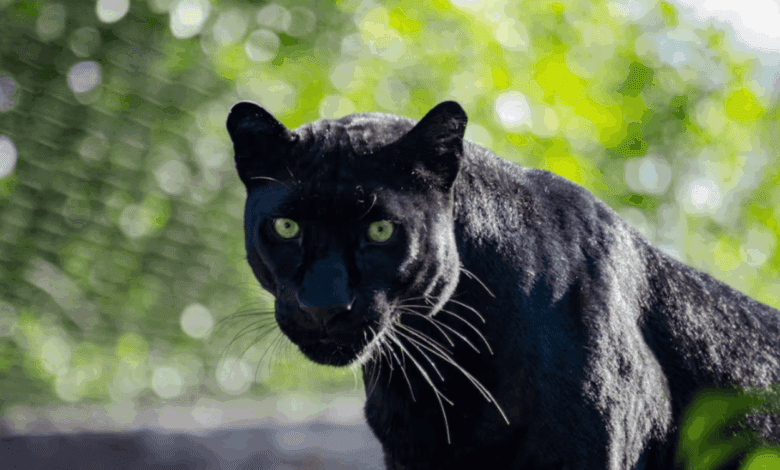
An era has ended at Valencia Bioparc: Mamba, the black panther, has died at the age of 21. She was one of the park’s most iconic residents and became a symbol of its endangered species conservation program. Mamba had lived at the Bioparc since 2008, arriving as a two-year-old cub from the Pont Scorff Zoo in France. Over the years, she became a favorite among staff and visitors, and her story is a testament to how care and attention can extend the lives of even the most vulnerable animals.
In the wild, leopards rarely live past 12 years, but Mamba nearly doubled that lifespan. Such longevity is extraordinary for a panther. In recent months, her health declined—age-related illnesses, including kidney failure, began to progress. Veterinarians and caretakers monitored her closely, performing regular checkups and surgeries to ease her suffering. Despite all efforts, Mamba’s condition worsened, and the difficult decision was made to perform euthanasia to spare her further pain.
Life at the Bioparc
Mamba was part of an international program for the conservation of leopards (Panthera pardus kotiya), a species threatened with extinction. The Biopark of Valencia became her home, where she not only received professional care but also lived in conditions as close as possible to her natural habitat. Over the years at the park, Mamba underwent two complex surgeries to remove malignant tumors, procedures that helped her avoid severe consequences from illness and allowed her to live several more years.
Biopark staff note that Mamba had a calm temperament and quickly adapted to life in her new environment. She became part of a large animal family, many members of which are also endangered. The park is home to more than a hundred species of African animals, including elephants, giraffes, lemurs, and chimpanzees. Mamba was one of the star attractions, drawing visitors’ attention with her striking appearance and graceful movements.
A rare mutation
Black panthers are not a separate species but leopards with a rare genetic mutation called melanism. This trait gives their fur a deep black color, although under certain lighting their characteristic spots can still be seen. Contrary to popular belief, black panthers are extremely rare, and their numbers in the wild are rapidly declining.
Over the past decades, the leopard population has declined by 30%. These animals have disappeared from 26 countries where they were once common. The main reasons are habitat destruction, poaching, and climate change. International conservation programs, including those Mambe participated in, aim to prevent the total extinction of these predators.
Remembering Mambe
Mambe’s death was a heavy blow for the Biopark team. Staff say they are proud of how they ensured she had a dignified old age and a high quality of life. During her years in Valencia, Mambe became not only the subject of scientific research, but also a true symbol of care for endangered animals.
Valencia Biopark spans 10 hectares in Cabecera Park, on the site of the former riverbed. Here, animals are kept in conditions as close to their natural habitat as possible. Many park residents, like Mambe, are listed in the International Union for Conservation of Nature’s Red List. The park’s staff continue their work preserving rare species, hoping Mambe’s story will inspire new visitors to care for nature and animals.