The history of Jaén has once again come into focus due to events that remained in the shadows for nearly ninety years. For Spaniards, this is more than just a memory of tragedy—it is an important lesson about the cost of war and the need to preserve historical memory. In 1937, the city suffered a massive airstrike, one of the most devastating for civilians in Andalusia. The impact of this event is still felt today in the city’s landscape and in public consciousness.
On April 1, 1937, rebel aviation under the command of Queipo de Llano struck the center of Jaén. The attack killed 159 people, left more than 200 wounded, and partially destroyed the city’s old quarters. This episode was so significant that Jaén began to be called the “Guernica andaluza”—the Andalusian Guernica. As El Pais notes, this moment proved pivotal in shaping local views on the war: while residents had previously viewed the conflict with a certain detachment, after the bombing the city became a war zone, its streets and homes in ruins.
Memory and Cinema
In 2026, a documentary premieres in Jaén, offering the first detailed account of the events of that day. Residents living in homes built on the site of destroyed buildings took part in the film’s production. Director José Laso Flores emphasizes that the project’s goal is to restore historical justice, honor the memory of the victims, and fill a gap in public dialogue. The film combines historical accuracy, social sensitivity, and active involvement from local citizens. The premiere is set for April 24, and experts believe this project will serve as an important tool to pass on memory to new generations.
Laso had previously made documentaries about the fate of guerrillas in the Sierra de Segura mountains. This time, he turns to a topic that has long remained out of the public eye. Mass bombings of civilian targets, first used during World War I, became one of the harshest tactics during the Spanish Civil War. The aim was not only to destroy infrastructure, but also to exert psychological pressure on the population to break their will to resist.
Shelters underground
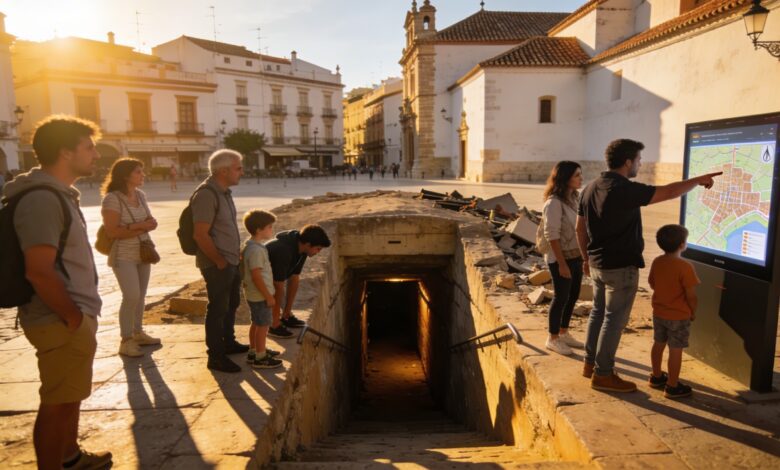
After the tragedy, authorities in Jaén were forced to urgently seek ways to protect local residents. With no air defense available, the primary solution became the large-scale construction of underground shelters. In a short period, the city transformed into a network of tunnels and hideouts, built both in public squares and the courtyards of private homes. The construction involved not only builders and workers, but also prisoners held in local jails. According to El Pais, between April 1937 and March 1939, around 150 shelters were built, of which 35 were public. Some of these shelters are now open to visitors, and their locations can be viewed on an interactive Google Maps map.
Among the best-known shelters are the one at Plaza de Santiago, recognized as an official site of Andalusia’s historical memory, and the shelter in the youth hostel building, which also holds monument status. Local tourist companies organize guided tours of these sites. According to experts, several more shelters may be restored and opened to the public, including those on Cuesta de San Miguel, Plaza de San Ildefonso, Plaza de la Merced, and Plaza Cruz Rueda. One of the new projects plans to use medieval water channels to create an educational space.
Education and tourism
Current initiatives in Jaén aim not only to preserve memory, but also to boost tourism. The municipality, governed by the coalition of PSOE and Jaén Merece Más, has launched the project “Jaén bombardeada, la Guernica andaluza,” making underground shelters part of the city’s cultural route. An interactive map allows residents and visitors to learn about each site, and some businesses, such as the Cervezas El Alcázar brewery and the Máquinas de Coser Singer factory, once built their own shelters for employees.
According to Santiago Jaén Milla, professor of contemporary history at the University of Jaén (Universidad de Jaén), visits to these shelters help foster democratic values and respect for human rights. His team used ground-penetrating radar to discover previously unknown structures beneath squares such as San Ildefonso, Cruz-Rueda, La Merced, and El Pósito. Their research formed the basis for a book on Jaén’s wartime heritage, highlighting the importance of combining education and tourism in preserving historical memory.
Context and parallels
In recent years, topics related to past tragedies and their impact on modern Spanish society are increasingly discussed. For example, following the tourist bus accident in La Gomera, which left one person dead and dozens injured, issues of safety and emergency response were debated. Such events, like analysis by russpain.com points to the consequences for the regions, serve as a reason to reconsider approaches to protecting the population and preserving the memory of tragedies.
Across various cities, efforts continue to restore and open sites linked to military history. These initiatives not only help boost domestic tourism but also enable society to better understand the lessons of the past. Attention to detail, involvement of local communities, and the use of modern technologies make these projects especially meaningful for future generations.