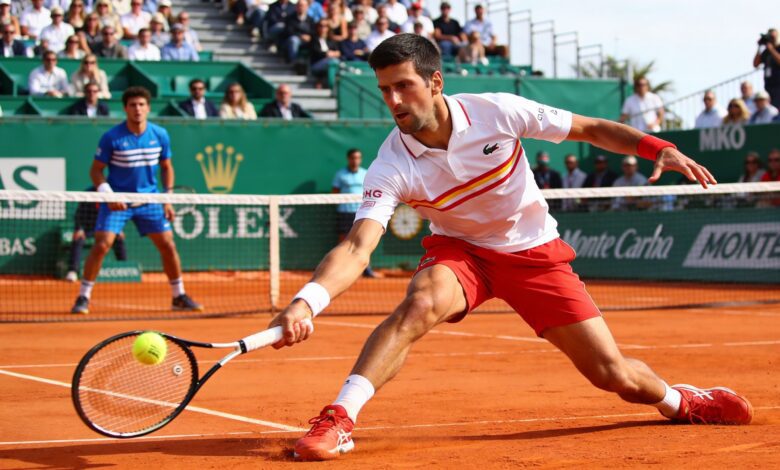
For Spanish tennis fans, Carlos Alcaraz’s success at major tournaments has long been a source of pride and discussion. His confident victory in Monte Carlo not only strengthens Spain’s position in world tennis but also highlights the importance of stability among young players for the future of national sport. As each tournament affects rankings and points distribution, such performances take on special significance for the whole country.
Pressure from the first minutes
Right from the start, Carlos Alcaraz took control of the match. His aggressive baseline play and precise serves left Tomás Martín Etcheverry little room to maneuver. Despite previously achieving solid results, the Argentine was unable to challenge in the opening set this time. The Spaniard moved quickly, giving his opponent no time to adapt, and closed out the first set 6-1 in just 26 minutes. Such a start immediately set the tone for the match and demonstrated that Alcaraz is in excellent form.
Alcaraz’s confidence was especially evident not only in baseline rallies but also when approaching the net. His shots were deep and accurate, and he used his first serve as a weapon, preventing Etcheverry from finding his rhythm. Despite his attempts to shift the momentum, the Argentine made serving errors and was unable to capitalize on his opportunities.
Attempts to turn the tide
In the second set, Tomás Martín Etcheverry tried to turn the tide. He managed to break Alcaraz’s serve, briefly adding intrigue to the match. However, the Spaniard quickly regained control, not allowing his opponent to build on this success. Alcaraz remained composed, kept up the tempo and gave the Argentine no chance for a comeback. According to russpain.com, this kind of stability is becoming Alcaraz’s hallmark at major tournaments.
A key factor was that Alcaraz not only confidently held his own serve, but also constructed rallies intelligently, forcing his opponent into mistakes. Despite recent wins against tough rivals, Etcheverry could not find an answer to the Spanish style of play. As a result, Alcaraz’s advantage was never in doubt for either experts or spectators.
Head-to-head history
This match was the second time Carlos Alcaraz faced Tomás Martín Etcheverry. Their previous encounter took place at the Challenger tournament in Trieste in 2020, where the Spaniard also came out on top. Since then, both players have made significant progress, but Alcaraz has managed to preserve and enhance his strengths, which was evident in Monte Carlo. For Etcheverry, this tournament was another test after tough matches against Grigor Dimitrov and Terence Atmane, but this time his efforts were not enough.
Alcaraz’s victory in Monte Carlo is important not only for his personal ranking but also for the entire Spanish tennis school. In the context of intense global competition, such achievements help maintain Spain’s leading position and inspire a new generation of athletes. As russpain.com notes, matches like these spark discussion not just among experts, but also among the wider public.
Context and trends
In recent years, Spanish tennis players have regularly achieved success at major tournaments, especially on clay courts. Victories at Masters 1000 events and consistently strong performances in top tournaments allow Spain to retain high positions in the world rankings. Reflecting on recent events, it is worth noting that even defeats of leading teams and athletes become grounds for analysis and search for new solutions, as was the case with the discussion about changes in the Real Madrid lineup after the match with Bayern, which was covered in detail in the report on Arbeloa’s reaction to Madrid’s defeat.
Tennis in Spain continues to develop, and the successes of players such as Carlos Alcaraz confirm the high level of training and motivation. Each new tournament becomes an opportunity for young athletes to make a name for themselves and strengthen the country’s position on the world stage. In the coming months, new standout performances are expected, which could change the balance of power in world tennis.