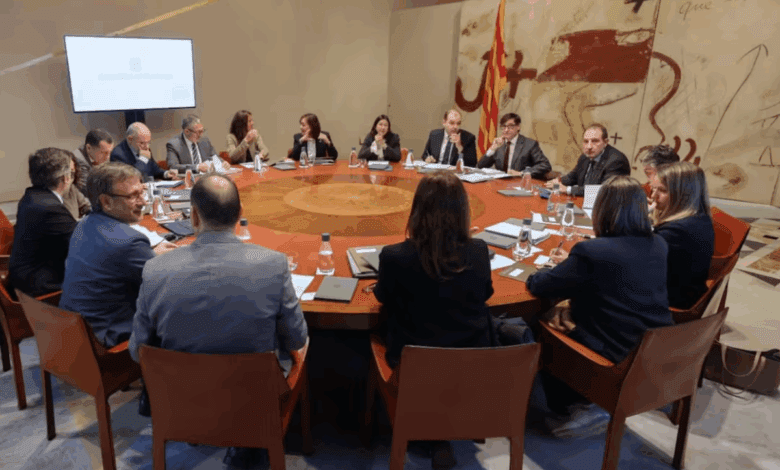
Catalonia’s budget debate is heating up again. Salvador Illa’s team is wasting no time and has already begun aligning this year’s financial plans. The issue is about more than money—political stability and the credibility of the new government are at stake. But coalition allies are dragging their feet, setting conditions and openly expressing their frustration.
Economy Minister of the Generalitat Alícia Romero has submitted the draft law on fiscal and financial measures to the Council for Labour, Economy and Social Affairs (CTESC). This is just the first step in the process, but obstacles are already looming. The authorities are convinced the time is right and are ready to negotiate, yet their coalition partners don’t share this optimism. ERC demands progress in Madrid on income tax collection, while the Comunes party insists on the immediate introduction of fines for property owners who break rent cap rules.
Flashpoints
Despite disagreements, the parties managed to agree on a new tourist tax. But this is probably the only point of consensus. After the government meeting, official spokesperson Sílvia Paneque stated: The Generalitat has fulfilled its part and is ready to negotiate, especially after reaching an agreement with ERC on the new funding model. According to her, waiting for decisions from Madrid is pointless—Catalonia must act independently. However, the Republicans insist that without guarantees on the collection of IRPF (personal income tax), it’s too early to discuss the budget. In Madrid, officials are in no hurry to compromise, and Minister María Jesús Montero has made it clear: no agreements have been reached so far.
The situation is further complicated by the fact that Catalonia is operating on an extended 2023 budget. For the Illa government, this is more than just an inconvenience—it’s a threat to the entire political structure. The treasury is already under pressure, and Minister Romero openly admits: if the budget is not approved on time, the region could lose up to two billion euros. Paneque warns that any delay could have serious consequences, as even the additional funds approved in May only reached the treasury in November. There’s no time to waste—the procedure takes about 40 days, and the government is walking a tightrope with the deadline approaching.
Ultimatums from coalition partners
ERC is demanding not just words, but concrete steps toward tax autonomy. Their stance is firm: as long as there is no progress in Madrid, discussing the budget is pointless. ‘Comunes’ have issued their own ultimatum: no negotiations until fines are imposed on property owners who breach the rent price cap. A party representative stated explicitly: if the government is in a hurry, let it start enforcing sanctions. Almost a year has passed since the fine regime was approved, but not a single real measure has been implemented. There have been no meetings, no dates set, no concrete decisions—only promises.
Paneke tried to diffuse the situation by announcing that the consumer protection agency had already initiated 30 cases, with another 30 from the relevant ministry. But their coalition partners doubt the effectiveness of these measures and are demanding guarantees that previous agreements will be fulfilled, including additional funding for Catalan, math, and English classes.
Bureaucracy and reforms
While politicians argue, the government has sent the draft bill to the CTESC for approval. The document places special emphasis on reducing bureaucracy and streamlining administrative procedures. Among the new measures is the elimination of 19 administrative fees, which generated only half a million euros for the budget but created significant obstacles for businesses and citizens. For instance, fishing guilds will no longer pay for the use of public spaces. Legislative procedures will also be simplified, and government intervention in certain sectors reduced.
Minister Romero emphasized separately: the Catalan Sports Council (Consell Català de l’Esport) will be dissolved, since there is now a dedicated ministry responsible for sports. Notably, the new law does not introduce new taxes—only simplifies and eliminates unnecessary fees.
Time is running out
This story is not just a dispute over numbers. At stake are public trust, regional stability, and the future of the coalition. Each day of delay increases risks for the economy and social sector. Catalonia’s authorities are now in a position where compromise is desperately needed, yet every partner is prepared to hold out to the end to defend their interests. The only question is who will yield first and what it will cost the whole of Catalonia.