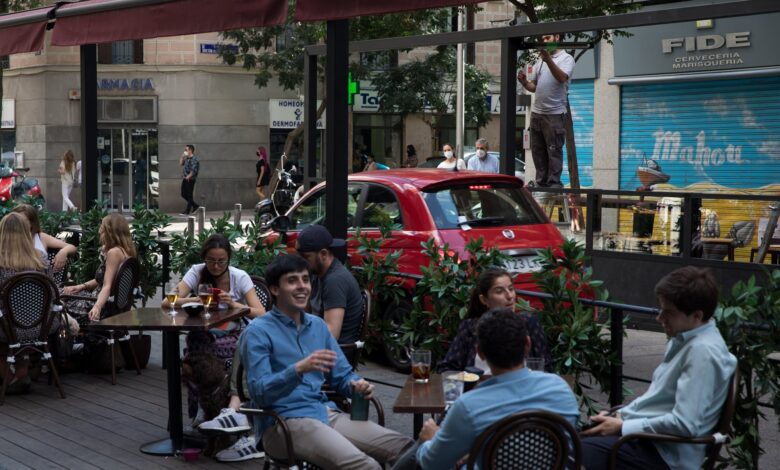
This news is significant for residents of Spain, as the dispute in question concerns urban mobility, access rights, and the traditional structure of city streets. Should the court continue proceedings, it could bring legal uncertainty for café owners and people with limited mobility. The contested regulation may shift the balance of interests between commerce and the protection of neighbors’ rights.
The claim was filed by the Federation of Regional Associations of Residents of Madrid (Fravm), with the case registered by the Sala de lo Contencioso-Administrativo on February 9. According to El Pais, the organization sees several inconsistencies between the new regulations and established court practices on mobility and accessibility. Fravm’s lawyers highlight that the provisions contradict building requirements and create a risk of violating the right to inviolability of the home due to noise.
Federation lawyer Raúl Maíllo outlined the legal basis for the complaint: in his assessment, the regulation’s provisions diverge from the Código Técnico de la Edificación and from the conclusions reached by the European Court of Justice on housing protection. The claim emphasizes that certain articles simplify the use of public spaces in a way that harms residents’ interests and the mobility of disadvantaged groups.
As deliberations begin, the court will assess how the new provisions align with established case law and current technical standards. If the court finds violations, it may partially or fully annul the contested items, repeating the scenario from two years ago. Previously, in 2024, the High Court of Madrid already struck down the first regulatory reform; the current case emerges roughly two years after that review.
The city government, led by José Luis Martínez‑Almeida’s team, stands by the document. Deputy Mayor Inma Sanz publicly described the regulation as ‘good,’ stressing the need to simplify the operation of summer and outdoor terraces for businesses. She also criticized the residents’ associations, calling their stance ‘completely negative,’ and reaffirmed the city’s readiness to defend the rule.
The review process takes time and creates uncertainty: entrepreneurs and residents do not receive timely answers to questions on permissible noise levels or changes in table placements. Judges must carefully balance municipal interests with existing technical codes and the right to decent living conditions. The outcome could set a precedent for similar regulations in other Spanish cities.
According to El Pais, this lawsuit marks another chapter in the ongoing standoff between local authorities and residents’ associations over the regulation of street commerce and public space. Acceptance of the complaint signals the start of a formal judicial review process, during which all disputed provisions and the arguments of both parties will be examined.
Background: two years ago, the Tribunal Superior de Justicia de Madrid (TSJM) had already annulled the first version of the terrace regulations, highlighting a systemic problem in aligning municipal decisions with legal standards. Such disputes typically revolve around balancing support for small businesses with protecting residents’ rights to comfort and accessibility. This case brings together issues of technical standards, urban governance, and European principles of housing protection, making the outcome an important precedent for other municipalities.