The mourning ceremony in Huelva became an event that touched every Spaniard. A large crowd gathered at the entrance to the Carolina Marín sports pavilion, where the mass for the victims of the Adamuz train disaster was held, turning the area into a real arena of emotion and symbolism. For many across the country, this day was not only a moment of grief, but also an occasion to reflect on the role of the authorities and the monarchy in society.
Despite the pouring rain, dozens gathered by the service entrance, hoping to catch a glimpse of high-ranking guests. The wait lasted nearly an hour, yet no one left. First to appear were members of the Andalusian government: Carolina España, Loles López, José Antonio Nieto, and Rocío Blanco. Their arrival was met with restraint, but when the president of the autonomous community, Juanma Moreno, approached, the crowd erupted in applause and loud cries of “¡Presidente!”.
Royal visit
By six in the evening, King Felipe VI and Queen Letizia arrived at the pavilion. Dressed in mourning, they immediately drew the crowd’s attention. People shouted “¡Viva el Rey!” and “¡Viva la Reina!”, while someone singled out the queen with a call of “¡Viva Letizia!”. The atmosphere at the entrance was tense, yet filled with respect and patriotism. For many, the monarchs’ presence became a symbol of support and unity in a difficult time.
At that moment, Vice President María Jesús Montero was already inside the building. She chose not to enter through the main entrance, where most of the crowd had gathered and where the royal couple and the president of Andalusia were being received. This gesture did not go unnoticed: those present continued to discuss it long after she appeared in the hall.
Memorial ceremony
The funeral mass was led by the Bishop of Huelva, Santiago Gómez Sierra, joined by three other bishops: President of the Spanish Episcopal Conference Luis Javier Argüello, Honorary Bishop of Huelva José Vilaplana, and Bishop of Córdoba Jesús Fernández. More than a hundred priests from various dioceses, including the abbot of Adamuz Rafael Prados, took part in the service.
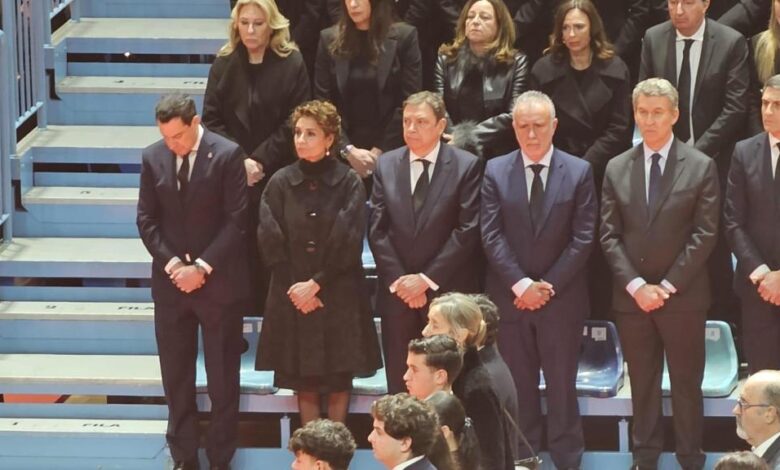
In the center of the sports complex, 500 chairs were arranged for the families of the victims, whose number exceeds 300. Around 4,500 people filled the stands, coming to offer condolences and support the loved ones of those lost in the tragedy. The entire hall was filled with an atmosphere of both mourning and unity as thousands prayed together for the deceased.
Emotions and symbols
This day in Huelva became not only a day of mourning, but also a moment when society demonstrated its solidarity. The crowd’s reaction to the appearance of politicians and monarchs showed how important the symbols of power and support are to Spaniards in difficult times. Every gesture, every word, even the choice of entrance to the building, took on special significance against the backdrop of the shared tragedy.
While some welcomed the guests with applause, others discussed the details of the ceremony and the conduct of government officials. That evening, the Carolina Marín pavilion became a place where personal dramas, public expectations, and political signals intersected. Perhaps it is precisely such moments that best capture the essence of modern Spain.