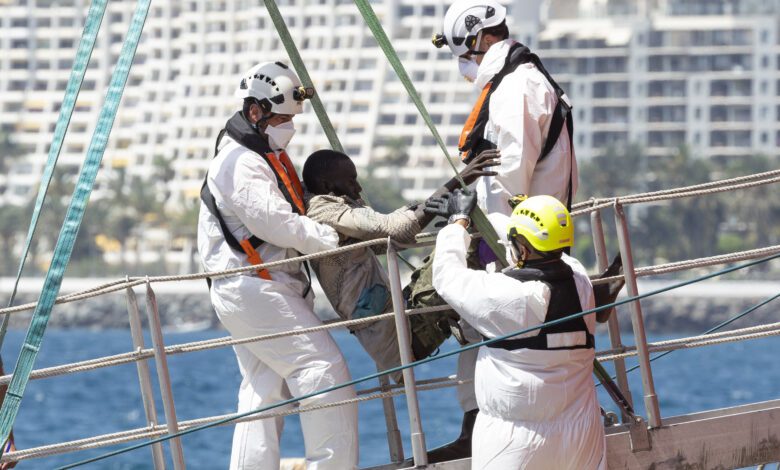
This week, the Canary Islands are hosting a delegation from the European Parliament aiming to assess the current situation related to migration. Despite a noticeable decrease in the number of arriving undocumented migrants compared to last year, the situation continues to raise concerns among local authorities and European institutions.
Over the course of three days, six members of the European Parliament’s Committee on Petitions plan to hold a series of meetings with Frontex staff and representatives of the European Asylum Agency. On Monday, the delegation will visit a primary reception center in Tenerife, followed by an evening meeting with regional government head Fernando Clavijo. He intends to highlight the special status of the Canaries as the EU’s external border and the need for support from Brussels.
On Tuesday, the MEPs will travel to Gran Canaria where they are scheduled to meet with representatives of migrant communities, local associations, judicial bodies, and the prosecutor overseeing cases of unaccompanied minors. A meeting with the central government delegate in the region is also planned.
The final day of the visit will focus on education and the integration of migrant children. The delegation will visit an educational institution to learn about the work of organizations that support minors, including those who have arrived on the islands without their parents. In addition, the MEPs will meet with representatives of the National Police, the Civil Guard, the Red Cross, and the maritime rescue service.
The delegation includes representatives from various political groups: committee chair Bogdan Żońca from Poland, as well as members from Italy, the Netherlands, and Spain — Carmen Crespo, Jorge Buxadé, and Sandra Gómez. This diversity allows the delegation to consider the issue from multiple perspectives and account for the interests of different EU countries.
A key item on the agenda is the issue of unaccompanied minor migrants. There are currently nearly five thousand of them in the Canaries, and regional authorities insist that the responsibility for their protection should be shared among all EU member states. Recent steps by the central government to distribute children among the autonomous communities have yet to fully resolve the problem, and local officials consider these measures insufficient.
In August, the first ten minors were placed in state shelters on the mainland, and in the near future the resettlement of another three thousand children is planned. The new regulation determines how many children each region must take in based on population size, but in practice, the system is still operating inconsistently.
The authorities of the Canary Islands emphasize that the migration crisis is not just a local issue, but a challenge for the entire European Union. They are demanding that the situation in the archipelago receive proper attention at the European level and that joint solutions be found, taking into account the region’s specific circumstances.