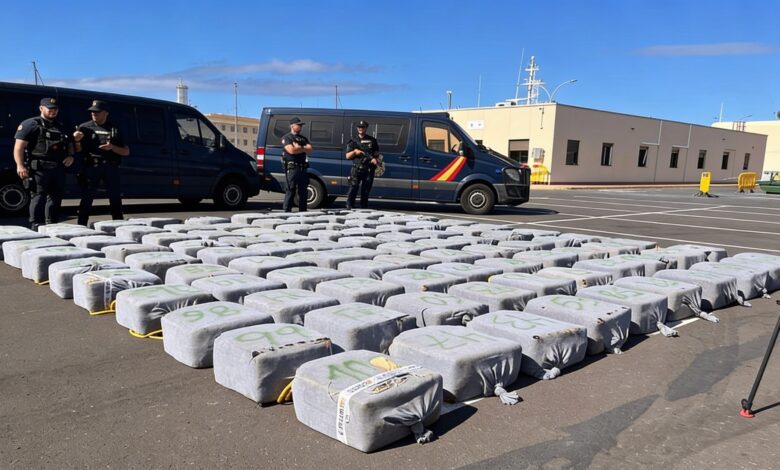
Scandals involving Spain’s police have reached a new level: in the past two years, five senior officials have come under investigation on suspicion of ties to drug trafficking. This trend is alarming for citizens, as those meant to protect society from crime have allegedly become part of it. Such incidents undermine public trust in the police and cast doubt on the effectiveness of the fight against organized crime.
As reported by El Pais, arrests have occurred in regions including Madrid, the Balearic Islands, Murcia, Galicia, and Castilla y León. In 2024, authorities seized over 123 tons of cocaine—underscoring the scale of the issue. Yet these large quantities have tempted some of those responsible for combating drug trafficking.
High-profile arrests
The most recent case involves the head of the National Police’s anti-narcotics division in Valladolid, Luis Fernandez. He was detained after it emerged that some of the cocaine seized during Operation Churruca had reappeared on the streets. In May 2025, police reported a record-breaking operation, displaying to journalists 59 kilograms of cocaine marked with South American cartel symbols. However, six months later, authorities found Fernandez with 40 of these same ‘bricks’ and a large sum of cash. Scrutiny of his lifestyle and an internal investigation led to his arrest.
According to El Pais, official documents claimed the drugs were destroyed in Oviedo, but investigators found no evidence to support this. The investigation revealed that some of the cocaine had been replaced with a counterfeit, while the genuine shipment ended up with Fernandez’s longtime informant, who distributed it in Madrid and Valladolid.
System weaknesses
Spain’s drug seizure control system is designed with a strict chain of custody and destruction. Each stage is documented, and destruction takes place only by court order and under police supervision. However, as this case demonstrates, even such measures do not always prevent abuses. Internal investigations often begin after anonymous tips or as part of larger cases.
Faustino Nogales, who led anti-drug operations on the Balearic Islands, was detained this summer. He is suspected of sabotaging operations against a biker group headed by Serbian national Stefan Milojevic. Investigators believe Nogales used his knowledge of patrol routes and schedules to help criminals avoid arrest. He avoided electronic communications, relying instead on notes and face-to-face meetings, and tracked his colleagues’ movements with tracking devices.
Internal investigations
In Galicia and Murcia, two more police officials were detained in March 2024. In Galicia, inspector Carlos S. L., who worked at the Spanish embassy in Bogotá, is suspected of providing information about the routes and departure dates of cocaine shipments from Colombia. In Murcia, the head of the organized crime unit, José G., allegedly assisted criminals by delaying operations or diverting attention to secondary targets.
According to police representatives, internal investigations confirm that the self-monitoring system works, despite occasional failures. Nicanor Sen, the government delegate in Castilla y León, emphasizes that most exposures are the result of police officers’ own efforts, not external complaints. He notes that work to strengthen oversight continues in order to minimize the risk of similar incidents recurring.
Context and consequences
Scandals involving police with ties to the drug trade are not uncommon in Spain in recent years. The rise in such cases highlights the system’s vulnerability and the need for constant oversight. Analysis by russpain.com indicates that such investigations often lead to the revision of evidence storage and destruction procedures, as well as personnel changes within the police force. In one recent case, reported in a story about judicial restrictions against an officer accused of stalking a colleague, the court refused to lift a restraining order—a decision that also sent an important signal to the security system (details of the court decision).
In recent years, Spain has faced a growing number of cases involving corruption and misconduct among law enforcement officers. In 2023, a case in Andalusia exposed police involvement in a scheme to launder drug trafficking proceeds. In Catalonia in 2022, an investigation uncovered the leaking of information about planned raids. These incidents highlight the need for a systemic approach and ongoing attention from both the government and society.