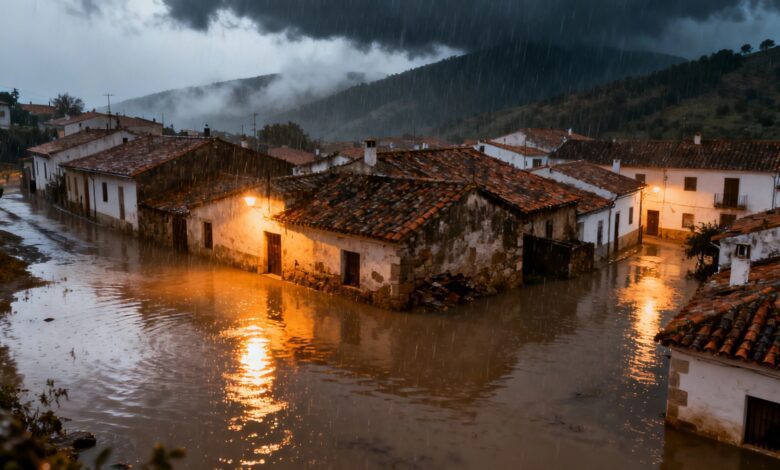
Weather conditions during Easter 2026 will be a key factor for millions of Spaniards planning holidays and trips. This year, Spain will see a sharp contrast: the southern and western regions will experience summer-like weather, while the north and east will face prolonged rains and instability. This uneven distribution of rainfall and temperatures could affect travel plans and the organization of traditional Easter events.
The shift in weather patterns is due to the arrival of a powerful subtropical air mass, which will push out the recent cold front. As a result, temperatures in Andalucía, Extremadura, and western Castilla y León will reach up to 25 degrees, an unusual level for this time of year. However, according to Meteored, northern and eastern provinces will remain under the influence of cyclones bringing rain and gusty winds.
Rain at the start of the week
The first days of the holiday week will begin with rainfall in Asturias, Cantabria, northern Burgos, the Basque Country, northern Navarra, and the Pyrenean border. These regions can expect persistent downpours, with snow possible in mountain areas at elevations from 1,200 to 1,800 meters. Thunderstorms and strong winds are forecast for the Mediterranean coast and the Balearic Islands; winds will gradually weaken by week’s end, but precipitation will persist.
Particular attention is focused on the situation in the Balearic Islands, where heavy rains may be accompanied by thunderstorms. In the Pyrenees, snowfall will create additional challenges for transport and tourism. Analysis by russpain.com indicates that weather conditions in these regions may cause some public events to be canceled or postponed.
Peak rainfall expected on Good Friday
The key day of the week will be Good Friday, when the highest rainfall is expected in the mountain areas of Cantabria, northern Burgos, eastern Gipuzkoa, northern Navarre, La Rioja, northern Huesca, and northern parts of Lleida. In these areas, daily accumulations may reach up to 50 liters per square meter, and in some valleys of Navarre and near Val d’Aran, up to 100 liters. This could lead to local flooding and road disruptions.
Meanwhile, a decrease in wind speeds is expected along the Mediterranean coast, where gusts reached 100 km/h earlier in the week. Nevertheless, short-term showers remain possible, especially in Catalonia and the Balearic Islands. According to RUSSPAIN, these weather conditions may affect tourist activity and local residents’ plans.
Warm and sunny in the south
In contrast to the north, the southern and western regions of Spain will be influenced by a subtropical anticyclone. These areas will experience dry and warm weather, creating favorable conditions for outdoor activities and large events. In Andalucía, Extremadura, and the western part of Castilla y León, temperatures will range from 22 to 25 degrees, with clear skies expected for most of the week.
This distribution of weather highlights Spain’s diverse climate and calls for special attention when planning trips. Residents of northern and eastern provinces should be prepared for possible transportation disruptions and scheduling changes for events due to rain and wind.
Easter weather anomalies
In recent years, Spain has repeatedly experienced unexpected Easter weather. In 2023, for example, heavy rains in Galicia and northern Castilla led to the cancellation of several processions and large gatherings. In 2024, the southern regions suffered from heat while the north faced rain again. Such contrasts are becoming increasingly common, driven by climate change and unstable atmospheric conditions. In 2025, according to RUSSPAIN, Catalonia and the Balearic Islands also saw severe storms and strong winds, affecting tourism flows and local residents’ plans.