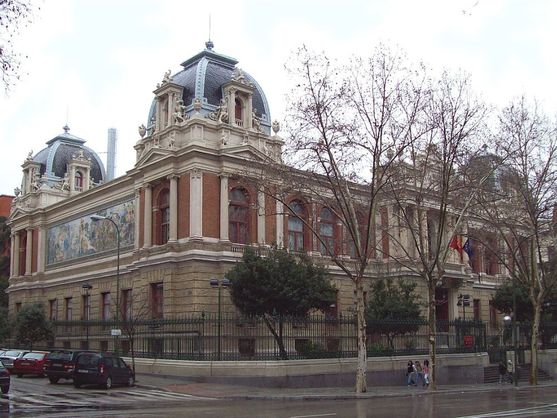
In the heart of Madrid, not far from the Nuevos Ministerios district, stands a building that rarely appears on tourist routes, yet impresses with its scale and history. This is the Higher Technical School of Mining and Energy (Escuela Técnica Superior de Minas y Energía) — one of the most beautiful and little-known educational institutions in the capital.
Architect Ricardo Velázquez Bosco designed this palace by combining metal, ceramics, and unique interior details. Each hall holds a wealth of fascinating stories. Renowned scientists have given lectures here, and in the early 20th century, a football club that would later become “Atlético Madrid” was founded within these walls. The showcases display rare relics connected to historic figures, giving the building a museum-like atmosphere.
The inner courtyard captivates with its design, while the historic library and mineral museum make each visit especially memorable. Both children and adults can explore an underground training mine that recreates a real mining gallery. The venue is a popular choice for family outings, especially during the mineral fair days.
The traditional mineral market is held in the first courtyard of the building on the first Sunday of every month, except August. On this day, September 7, collectors and enthusiasts can find minerals, fossils, gemstones, and shells. The event is open to everyone from 10 a.m. to 2 p.m., admission is free, and entrance is at Ríos Rosas, 21. In addition to purchasing items, visitors can admire the architecture and add to their collections. Workshops and museum and mine tours are usually organized for children, making it an interesting outing for the whole family.
The history of the building dates back to the 18th century: the school was originally founded in Almadén and moved to Madrid in 1835. The current building was constructed in 1893, featuring a rectangular layout with a central courtyard under a glass roof and arcades supported by cast-iron columns. The facades are decorated with ceramic panels depicting scientific and mining themes.
Inside, you’ll find galleries with metal frameworks and bright halls. The second floor houses symmetrical rooms, originally designed for the library and museum, with no windows so that long rows of cabinets could be placed there. The fence, designed by the architect, is adorned with elements reminiscent of fossils. These spaces have often been used as backdrops for filming TV series and movies featuring government institutions. Among them are well-known productions such as “Cuéntame”, “El Comisario”, and “Estoy vivo”.
Later, a second building with a ceremonial hall was added to the main structure, hosting concerts and ceremonies. In the 20th century, another academic building was constructed on Alenza Street to expand the laboratories and classrooms.
The top floor of the palace houses a museum featuring minerals, fossils, mining lamps, scientific instruments, and models illustrating two centuries of mining history. Many exhibits come from historic mines and are linked to renowned engineers. The traditional decor, with wooden display cases and overhead lighting, creates the atmosphere of a 19th-century scientific study.
Visiting the mineral market is a great opportunity to discover this unique building. The museum tour also offers a chance to descend into a training mine, built in the 1960s for student practice. Here, you can see real mine carts, supports, and equipment. Entry to the mine is allowed only with a guide and for a small fee, but even if the mine is temporarily closed, the remaining exhibits will leave a strong impression on visitors of all ages.