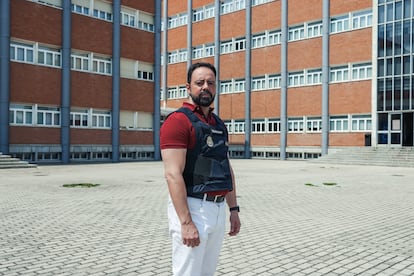
Spain has a special group of police officers whose job is to make contact with people in the most critical situations. These specialists undergo more than standard training: they are taught to maintain composure when human lives are at stake and decisions must be made in a matter of minutes.
At one of Madrid’s police facilities, future negotiators are faced with unusual challenges. For example, how do you convince a person standing at the edge of a precipice if they can’t hear a word? Such scenarios aren’t fiction—they’re part of real training. In one case, an inspector had to use sign language and even cigarettes to establish contact with a desperate man. For two and a half hours, he gradually narrowed the distance until the man was safely out of danger. In such moments, it’s crucial not only to listen, but also to show respect for the person’s feelings—even when the situation seems hopeless.
The network of negotiators in the country counts just over fifty members. Each has gone through a rigorous selection process and training, where their resilience is tested along with their ability to think outside the box. During training, candidates are sent on assignments where they can’t use phones or money, and their goal is to persuade strangers to help them. Sometimes they must overcome a fear of heights or work in confined spaces, since in real life negotiations can take place on construction cranes or cathedral rooftops.
Being a negotiator is not a primary position but an additional specialization. Many negotiators also work on kidnapping investigations, migration issues, or family cases. New team members undergo courses that are regularly updated: this year, the training started for the fourth time, and after completion, another two dozen specialists will join the team. There is a particular need for such professionals in regions where crises often occur — for example, in Málaga, Cádiz, or Alicante.
Before negotiations begin, the team carefully gathers information and develops a strategy. Unlike tactical units, negotiators operate independently but are always ready to support each other with advice or expertise. Most cases involve suicide attempts or family conflicts, but sometimes they must deal with kidnappings, where both time and hostage lives are at stake. Every detail matters in such operations: sometimes information arrives late, and sometimes the negotiators have to work almost blindly.
Despite constant tension, many note that the satisfaction after a successfully resolved case outweighs all the difficulties. It’s important to remember that success depends not on one person, but on the coordinated work of the entire team. Even the most experienced negotiators admit that failures do happen, and such cases remain in memory for a long time. But every new challenge is an opportunity to improve and save another life.