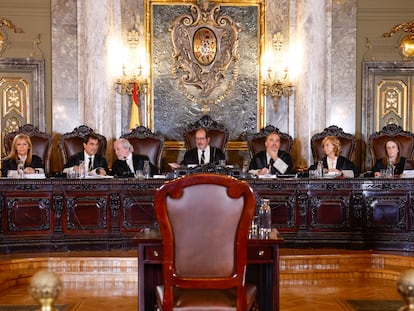
The Supreme Court of Spain has issued a ruling in the case against the country’s Attorney General, Álvaro García Ortiz, and the language of the document has raised many questions among legal and linguistic experts. Attention has been drawn not only to legal specifics but also to how the judges have worded their conclusions. The 180-page decision includes expressions that blur the line between established facts and assumptions. This is not just a matter of style—such wording can impact the understanding of the case itself.
The ruling frequently uses verbs that express possibility or probability, even when referring to events that seemingly have already been proven. For example, the judges write that certain information ‘could have been obtained’ by the newspaper with the prosecutor’s permission, even though there is no direct evidence of this. According to some linguists, such turns of phrase create a sense of uncertainty and can confuse even experienced readers.
Grammar and justice
The use of the so-called ‘conditional mood’ in legal documents is not uncommon, but in this case, it takes on particular importance. The court’s decision features phrases like ‘the newspaper could have obtained the document with the prosecutor’s permission,’ which in practice means: if this happened, it would have been only under certain conditions. However, in the section addressing proven facts, such wording seems out of place and raises doubts about the strictness of the exposition.
Linguists note that such constructions are common in journalism, where they are used to convey rumors or unconfirmed information. However, in court decisions, where every word carries weight, their use can create ambiguity. As a result, readers may not always understand whether the text refers to real events or hypothetical scenarios.
Questionable conclusions
In some cases, judges draw conclusions based on indirect evidence rather than direct proof. For example, it may be stated that a certain letter ‘must have come’ from the prosecutor’s office, even though no one saw the actual moment it was delivered. This is a typical example of deduction, when one fact is inferred from another without having a complete picture of what happened.
Such formulations may be acceptable in everyday speech, but in legal documents they raise concerns. If the court is confident in its findings, why not simply write: ‘The letter came from the prosecutor’s office’? This lack of certainty in language can be seen as a sign of insufficient evidence or a desire to allow room for interpretation.
The role of assumptions
The court decision contains other phrases that indicate assumptions. For example, it is stated that messages on the phone could have been deleted before the defendant learned about the investigation. However, the defendant himself claims he deleted them earlier, and experts were unable to determine the exact deletion date. As a result, the judges use wording that leaves room for doubt.
Another example is the use of the verb “infer” (to draw a conclusion). The judges write that it is “logical to assume” certain actions were taken not according to the law, but as part of a defense strategy. But logic does not always equal truth: sometimes conclusions turn out to be mistaken if the initial data is incomplete or misinterpreted.
Language and perception
Despite some debatable points, overall the text of the decision is written quite clearly, even taking into account legal specifics. However, an excessive fondness for complex constructions, frequent use of capital letters, and commas that aren’t always necessary may make it harder for non-specialists to understand. As a result, readers may get the impression that the judges themselves are not entirely confident in their conclusions.
Such a style not only complicates comprehension, but can also shape public opinion about the case. When official documents allow for ambiguity, it creates room for speculation and conjecture, which is especially dangerous in high-profile cases.
If you didn’t know, Álvaro García Ortiz has served as the Attorney General of Spain since 2022 and has repeatedly been involved in high-profile legal cases. His work often sparks debate within the legal community and among politicians. The Supreme Court of Spain is the country’s highest judicial authority, and its decisions have a considerable impact on legal practice. In such cases, every word in the ruling can become a topic of discussion or even change the course of future events.