In Adamuz (Adamuz), located in the province of Córdoba, the investigation into the railway disaster involving the Iryo train has entered a new phase. Experts have concluded that the cause was a crack in the rail, which had appeared long before the fatal incident. This discovery has changed the understanding of the accident’s causes and called into question the effectiveness of track condition monitoring.
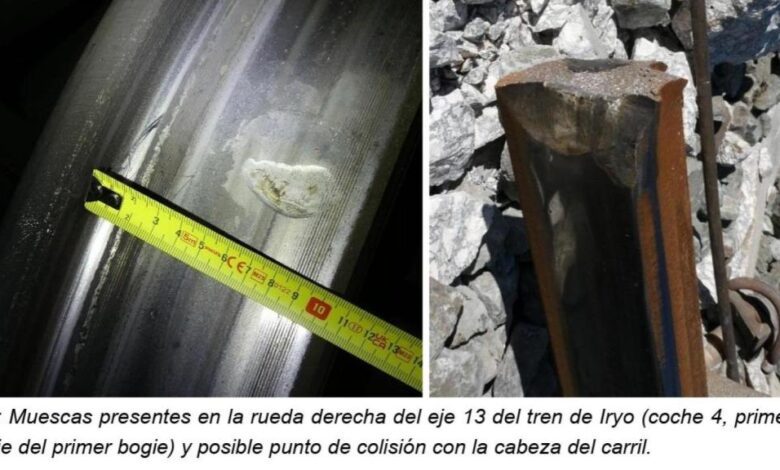
Experts who examined the damage discovered distinctive marks on the wheels of the affected train. These marks were especially pronounced on the right wheels of cars numbered 2, 3, 4, and 5. Interestingly, the damage pattern on three of them matched down to the smallest detail, indicating a single mechanism behind the defect. The traces resembled impacts against a protrusion on the rail, which formed due to metal deformation just before the crack.
Details of the incident
The crack in the rail appeared before the ill-fated train passed over it. As the train moved, the rail bent downward under the weight of the wheels, creating a kind of step. This was what caused the dents on the wheels. At a speed of about 200 km/h, the second pair of wheels never hit this protrusion—the rail didn’t return to its original position after the first impact.
Car number 5 stood out: its wheels showed a different type of damage. This led to the assumption that at the moment this carriage passed, the rail began tilting outward. As a result, the sixth carriage lost support and derailed. At the crash site, experts saw that the rail beyond the fracture point had been literally bent outward, with traces of the wheels hitting it from the side.
Investigation progress
The wheels of carriages 6, 7, and 8, which completely derailed, were not analyzed. Investigators assume that these carriages no longer made contact with the railhead after it was damaged. This approach allows for a more accurate reconstruction of the timeline and a better understanding of how the accident unfolded.
Interestingly, similar dents were found on the wheels of other trains that passed through the area before the tragedy. These included one Renfe Viajeros train and two Iryo trains. This confirms that the crack in the rail had existed beforehand, meaning the accident could have been avoided with more thorough inspection.
Next steps
Experts emphasize that all conclusions remain preliminary. Final answers will require laboratory tests on rail fragments. Metallographic analysis will help determine why the crack formed and how long it had existed. In addition, data from the onboard recorders of all trains that traveled through this section will be studied to identify any possible additional factors.
The accident in Adamuz once again raises concerns about the safety of Spain’s railway infrastructure. Clearly, even minor defects can lead to catastrophic consequences if not detected in time. Questions about the control system remain unresolved, and passengers are waiting for answers and safety assurances.