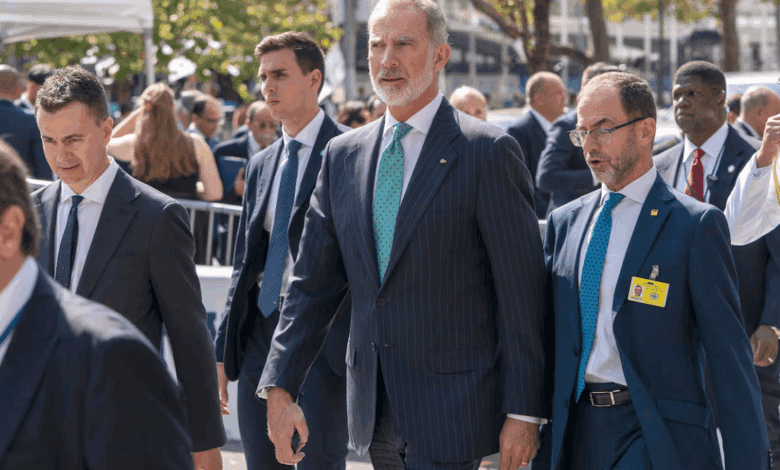
For the first time in nearly a decade, Felipe VI appeared again at the UN podium. His return to New York coincided with a time when the world’s attention is focused on events in the Middle East. In recent months, European countries have been recognizing Palestine one after another, with Spain at the center of this process.
The content of the monarch’s speech was kept secret until the very last moment. Spanish authorities actively debated how firmly the king should address the situation in Gaza. It was expected that the speech would be as direct as possible, although whether the word “genocide” would be used remained an open question. The government pushed for its inclusion, but the final decision rested with the royal palace. In the end, as anticipated, Felipe VI emphasized the need for a viable Palestinian state—including Gaza, the West Bank, and East Jerusalem—and highlighted the importance of peaceful coexistence with Israel. He especially pointed out the unbearable humanitarian crisis and the high number of civilian casualties.
This statement has further narrowed the room for maneuver for the opposition People’s Party (PP), which had recently softened its position and even expressed willingness to support the recognition of Palestine, provided that HAMAS is not involved in governance. A similar approach is now being taken by Italy’s Prime Minister Giorgia Meloni, who has found herself isolated in Europe on this issue. Meanwhile, even Portugal, where the Spanish conservatives’ ally is in power, has already recognized Palestine, as have France, Canada, Australia and a number of other countries.
Felipe VI’s speech stands in stark contrast to the views of the most radical representatives of the PP, such as Madrid’s leader Isabel Díaz Ayuso, who fully supports Israeli Prime Minister Benjamin Netanyahu. At the same time, the King’s position aligns with the policy of Sánchez’s government, which is pleased to see more countries backing the Spanish initiative to recognize Palestine. This lends particular significance to the monarch’s words, since any statement he makes that echoes the government’s official line inevitably generates political resonance.
Negotiations over the speech between the government and the royal court were tense, as is often the case before major international statements. Ultimately, the final version of the text was determined personally by Felipe VI and his inner circle. The People’s Party insisted that the term “genocide” should not be used, and even appealed to the President of Congress, requesting that the word not be spoken during the moment of silence for the victims in Gaza. However, their request was not granted, while VOX refused to participate in the ceremony altogether, demanding the removal of any mention of Palestine.
Although the conflict in Gaza was the main topic of the summit, the King also addressed issues aligned with the position of Sánchez’s government. During a meeting with the Spanish diaspora in New York, he stressed the importance of strengthening multilateral cooperation and the role of the UN in maintaining an international order based on law. Over the past decade, the global situation has changed drastically: if Felipe VI’s previous address coincided with the UN’s 70th anniversary, now even the US is questioning established rules, and Donald Trump once openly criticized the organization. Against this backdrop, the Spanish Prime Minister opted not to engage in public disputes with the American leader, limiting himself to closed-door talks and canceling several interviews.