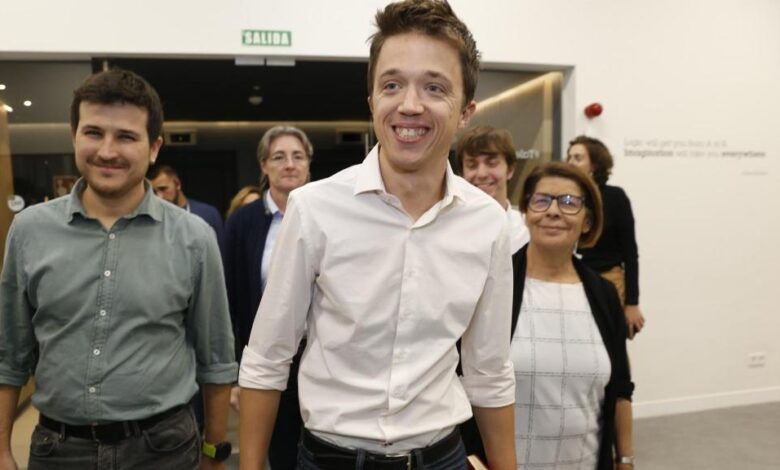
A whole era ends at Más Madrid. With the departure of Pablo Gómez Perpinyà, the party is definitively saying goodbye to Íñigo Errejón’s legacy. Perpinyà, long regarded as the founder’s right-hand man, announced he is stepping down as deputy and returning to teaching law. His decision is more than just another resignation—it marks a symbolic close to the entire political line associated with Errejón.
The party, established in 2018 together with Manuela Carmena, has completely changed its face in recent years. After Errejón moved to national politics and Mónica García consolidated her position during the pandemic, the old guard’s influence quickly faded. Perpinyà, once one of the most prominent figures in regional politics, gradually found himself sidelined.
Losing ground
The alarm bells first rang after the 2021 elections, when Perpinyà lost his post as Assembly spokesperson. Then, following the 2023 elections, he was told he would not be put forward as a senator—the seat went to Carla Antonelli. For many, this was a clear signal: the party was moving on from Errejón’s allies. Perpinyà himself did not hide his disappointment, and his exit was marked by a noticeable cooling of relations with the leadership.
Officially, the reason for his departure was a return to teaching at the Universidad de Extremadura. However, the farewell letter published on social media revealed far more emotion than the dry language of press releases. In it, Perpiñá openly spoke about disagreements and disappointments, and even hinted at the danger of the party becoming a tool for a single person. These words were clearly directed at Mónica García, who now has full control of the party’s political agenda.
Internal fault lines
Perpiñá’s exit is not the only high-profile split within Más Madrid in recent months. In March 2025, Loreto Arenillas also resigned her mandate after falling out of favor following a scandal involving Errejón. That moment, marked by a public appearance from Mónica García, Rita Maestre, and Manuela Bergerot, definitively cut the party off from its founder and his circle. It became a turning point that ushered in a new chapter for the movement.
Since then, Más Madrid has been actively restructuring its internal organization and seeking a role within the broader Sumar coalition. Errejón’s old allies, such as Jorge Moruno and Emilio Delgado, have formally remained in the party but chose to distance themselves from the former leader, especially after harassment allegations. The influence of Errejón and his supporters has all but disappeared, both in terms of decision-making and symbolic presence.
New rules of the game
With Perpiñá’s departure, it’s not just the end of a personal story—it marks the close of an entire political era. Caution now prevails within the party: leaders are careful to avoid open conflict or public disputes. Even Mónica García, who is clearly in a dominant position, has chosen to thank her former colleagues rather than escalate tensions. Still, unease lingers—especially among those who, until recently, were among Errejón’s closest allies.
Significantly, Emilio Delgado—who plans to compete for leadership in the future—has publicly voiced his support for Perpiñá, calling him a friend. This gesture goes beyond courtesy; it signals that the struggle for influence within the party is far from settled. Still, Más Madrid is now a very different entity, leaving little room for old symbols and familiar names.
An era comes to an end
Más Madrid continues to operate, but now without Errejón and his team. The party is now firmly under the control of Mónica García, who has become the face of the new left in Madrid. Internal battles, generational turnover, and painful splits—all underscore how rapidly the political landscape is changing. Perpiñá’s exit isn’t just a personnel move; it’s the final note in the story of one of the most dynamic political groups of recent years.