The fate of Spain’s artistic treasures is often shrouded in intrigue. One of the most valuable Gothic paintings, once adorning the Church of San Miguel in Villalpando, was long believed lost forever. Now, more than seventy years after its disappearance, the artwork has resurfaced in the spotlight—this time, in the halls of a Massachusetts museum. The story of its rediscovery is a true detective tale, intertwining a passion for art, modern technology, and the painful reckoning with loss.
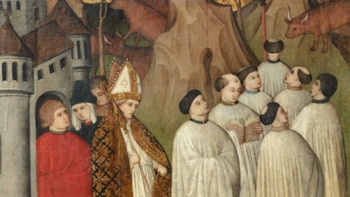
The painting ‘Procesión al Monte Gargano,’ created in the 15th century and attributed to Nicolás Francés, was for many years part of an altarpiece in a modest church of Castilla y León. But in the mid-20th century, faced with an urgent need for renovation funds, several Gothic masterpieces were sold for what today seems a trivial amount—about 30 euros. At the time, no one could have predicted that these works would vanish from public view for decades.
Traces Lost
After the sale, the paintings went to the private collection of Baroness Anita Breuille in Córdoba. Their subsequent fate became enveloped in mystery. It was only in 2013 that it was discovered that three of the four panels had ended up in Spanish museums—in Montserrat, at the National Art Museum of Catalonia, and in Cincinnati. But the whereabouts of ‘Procesión al Monte Gargano’ remained unknown. It seemed the trail had gone cold for good.
Everything changed last summer when a researcher from Zamora decided to resume the search. He came across an old negative—the only existing image of the missing painting—taken by a Catalan architect and collector. After digitizing the photo, he used Google Lens to look for any possible leads. Incredibly, the system produced a result: the painting was on display at the Springfield museum in the United States, though its origins were unclear.
Technology and chance
Modern technology played a decisive role in this case. Without artificial intelligence and digital archives, this story would likely have remained unresolved. But even after the painting was found, many questions lingered. How did it cross the ocean? Why did no one know it was from Spain? The answers started to surface only after the museum agreed to cooperate and granted access to its archives.
It turned out that along with “Procesión al Monte Gargano,” the museum acquired another retablo originating from a different Spanish church. Both works were purchased in the mid-20th century, a time when European art was being exported en masse to the US. Few considered the cultural value of such pieces back then—money and the need to resolve everyday problems quickly took precedence.
The cost of loss
Today, with all four panels dedicated to Saint Michael finally discovered, a natural question arises: is it possible to reunite them? Three are housed in Spanish museums, one in America. The idea of bringing them back to Villalpando, even temporarily, seems almost utopian, yet that is precisely what the researcher who spent years searching for them hopes to achieve. He does not hide his disappointment: masterpieces like those of Nicolás Francés should never have left their homeland for a pittance.
Still, even if a temporary reunion does happen, the scars of loss will remain. The story of selling off these Gothic masterpieces is not just about money, but about indifference to one’s heritage. In the middle of the last century, Spain lacked both the resources and the awareness that such paintings are part of the national identity. Today that understanding exists, but what has been lost is impossible to recover.
Shadows of the Past
Curiously, the fate of the other six paintings from the same lot remains unknown. At the time of sale, their value was just 50,000–60,000 pesetas—barely 350 euros by today’s standards. Where are they now? Perhaps decorating someone’s private collection or gathering dust in the reserves of foreign museums. Each such case is a reminder of how easily we can lose what took centuries to create.
Other works by Nicolás Francés can still be seen in Spain—in the León Cathedral and at the Prado Museum. But the story of ‘Procesión al Monte Gargano’ has become a symbol of how art can disappear and then suddenly reappear when passionate people and modern technology come together. And perhaps this is the only reason for optimism in this story.