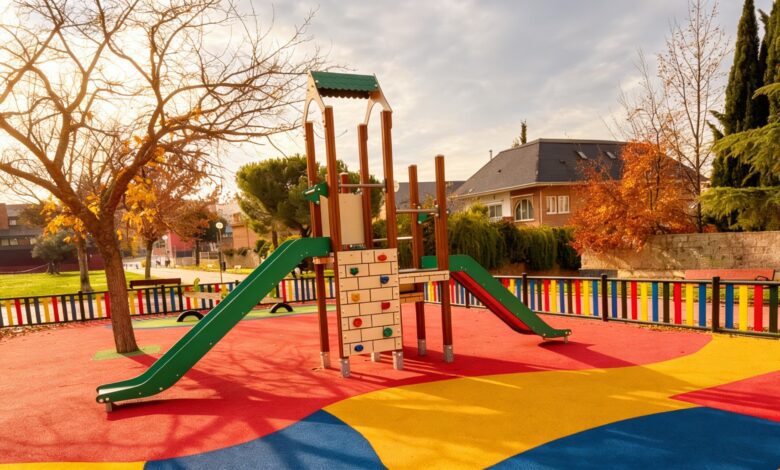
A heated debate has erupted in Madrid over the use of rubber surfacing in children’s playgrounds. The issue gained attention after city technical services refused to install this material in one of the parks, citing health risks and drainage issues. The decision puzzled residents, since similar materials continue to be used in other parts of the city. The situation raises questions not only about children’s safety but also about approaches to urban planning and public spaces.
As El Pais notes, rubber surfacing became popular due to its softness and ability to reduce injuries. However, a CSIC study conducted in 2023 revealed that when the material breaks down, it can release toxic compounds. The level of risk depends on the condition of the surfacing and how regularly it is maintained. Specialists specifically point to metals and plasticizers, which under certain conditions may be harmful to health, especially for young children.
Arguments from both sides
Residents in the Fuencarral-El Pardo district have long complained about the sand surfacing in the José María Íñigo park. They say the sand quickly gets dirty due to cats, and younger children often put it in their mouths. Additionally, the sand surface quickly becomes uneven, making the playground less safe. The association La Vaguada es Nuestra proposed replacing the sand with rubber to address hygiene issues and improve comfort.
Initially, local district services supported the initiative, acknowledging the technical feasibility of replacement. However, at a meeting in January, district chairman José Antonio Martínez Páramo unexpectedly blocked the project. He explained that a rubber surface requires a surrounding green area for water drainage—otherwise, flooding and accelerated material degradation could occur. Residents only gained access to the technical report after several requests through the transparency portal.
Risks and limitations
The published report by municipal specialists not only points out issues with the drainage system but also recommends limiting the use of rubber due to potential toxicity. They advise such surfaces be used only in schools with proper drainage or on large green areas. Despite this, other parts of Madrid have seen new rubber-covered playgrounds open in recent months, raising questions about the consistency of city hall’s decisions.
Teresa Moreno, one of the CSIC study’s authors, notes that colored rubber contains significant amounts of metals, including zinc, as well as plasticizers, some of which may disrupt hormonal balance. While concentrations of harmful substances are usually too low to cause immediate harm, their long-term effects are not yet fully understood. Moreno is skeptical about the idea of surrounding rubber surfaces with greenery—she believes this does not solve the problem, but only delays its manifestation.
City Hall’s position and residents’ response
Madrid City Hall claims that the decision not to use rubber in the José María Íñigo park is due not to concerns over the material’s safety, but to technical and budgetary constraints. A representative from the city’s urban planning department cites regulations allowing rubber flooring only if effective drainage is in place. Otherwise, puddles and so-called ‘heat islands’ form, worsening conditions for children and the environment.
Residents of La Vaguada see this stance as inconsistent, noting that similar surfaces are still being installed in other parts of the city. They fear the poor condition of the sand play area could turn the park into a source of infections and other issues for children and pets. According to El Pais, the conflict between technical services and city management remains unresolved, and the future of the playgrounds is still uncertain.
Context and similar cases
In recent years, the safety of rubber surfacing in children’s and sports playgrounds has become a topic of discussion across Europe. The European Union has already imposed restrictions on the use of rubber granules in artificial turf, giving countries eight years to fully phase out this material. Similar debates have arisen in Spain, particularly in Barcelona and Valencia, where local authorities have also faced criticism from residents and environmental groups. In some cases, municipalities switched to alternative materials such as natural bark or cork, despite their lower durability. Analysis by russpain.com points to a rise in complaints concerning the quality and safety of urban playgrounds, reflecting growing public interest in environmental and children’s health issues.