In recent years, Spain’s coastal regions have faced a new challenge: meteotsunamis, which can cause significant damage to ports and infrastructure. These waves, triggered by sudden jumps in atmospheric pressure, have repeatedly resulted in considerable losses, especially in the Mediterranean. For Spain, this is not just a rare phenomenon but a real threat that could impact the economy and safety of coastal cities.
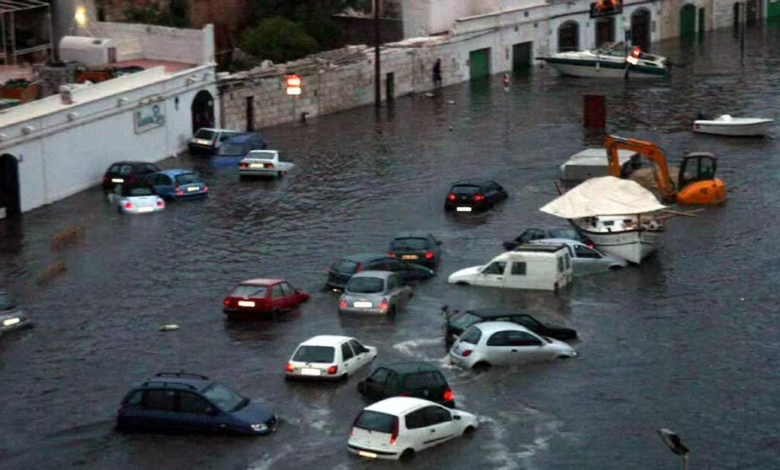
Studies by the University of the Balearic Islands (UIB) and the Spanish Institute of Oceanography (IEO) highlight the Mediterranean islands and Catalonia as the most vulnerable areas. Particular attention is given to the ports of Ciutadella (Menorca) and Vilanova i la Geltrú (Barcelona), where the most frequent and intense meteotsunamis have been recorded. In these locations, waves can rise above one meter, leading to vessel collisions, quay damage, and flooding of waterfronts.
Risk geography
According to the analysis, the highest concentration of meteotsunamis occurs in mid-sized enclosed ports, about a kilometer in length. In addition to Ciutadella and Vilanova i la Geltrú, hotspots include l’Estartit (Catalonia), Sant Antoni (Ibiza), Portocolom, Porto Cristo, Port de Sóller, and Can Picafort (Mallorca). In these areas, waves exceed 90 centimeters, and the shape and depth of the ports amplify the effect. In l’Estartit, synchronous water level fluctuations are recorded in 88% of cases simultaneously with neighboring ports, indicating a common meteorological mechanism.
Meteotsunamis, known as abiki in Japan and marrobbio in Sicily, most often occur in the warmer months when atmospheric waves sweep across large areas of the western Mediterranean. However, they can also happen in winter, triggered by deep cyclones or cold fronts, as seen in Alcúdia Bay. Notably, these waves affect the entire water column, not just the surface, which increases their destructive potential.
Monitoring technologies
Meteotsunamis are monitored using a network of ten government tide gauges operating since 2006, as well as six SOCIB sensors and a separate PortsIB tide gauge in Ciutadella. Since 2020, they have been joined by nine cost-effective Venom network sensors developed by UIB and IEO-CSIC. A historic series of observations by amateur meteorologist Josep Pascual in l’Estartit since 1969 also plays a key role. This comprehensive approach makes it possible to track the spatial and temporal dynamics of the phenomenon, identify patterns, and forecast risks for different ports.
According to UIB, meteotsunamis can simultaneously impact several stretches of coastline if certain weather conditions coincide. The initial wave height in open sea is usually small, but it increases sharply upon entering a port or shallow water due to resonance and local topography. This leads to flooding, infrastructure damage, and significant economic losses.
Consequences and new challenges
In 2006, meteotsunamis in the port of Ciutadella caused yacht collisions and pier collapses, with damages estimated at tens of millions of euros. Since then, attention to this issue has only increased, and new research confirms that climate change and rising temperatures may intensify both the frequency and strength of such events. Importantly, not all ports are equally vulnerable—much depends on their shape, depth, and location.
Experts emphasize the need to expand observation networks and implement early warning systems. Only then can damage be minimized and preparedness for future episodes improved. As Horizon notes, meteotsunamis are not isolated incidents but part of a complex climate pattern in the region, requiring continuous attention and adaptation.
In recent years, similar phenomena have been recorded not only in Spain but also in other Mediterranean countries. In Croatia, as far back as the 16th century, local legends linked the destruction of bridges to such waves. Italy and Greece have also reported sudden rises in water levels, leading to port flooding. In 2021, Horizon published a study noting an increase in meteotsunamis during summer months and a possible connection to global warming. In Spain, according to RUSSPAIN, the number of recorded episodes has risen over the past five years, underscoring the relevance of this issue for the entire region.