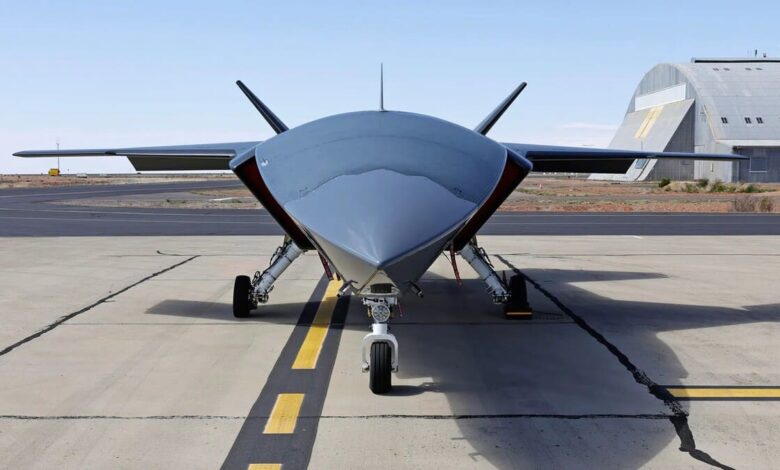
The Australian MQ-28 Ghost Bat unmanned aerial vehicle, developed by Boeing’s division, is preparing for its first test launch of the AIM-120 air-to-air missile. This milestone marks the project’s transition to a new phase, as the drone will be able to deploy live weaponry under real-world conditions for the first time.
The MQ-28 program, launched at the request of the Royal Australian Air Force (RAAF), has already completed an extensive testing cycle with eight prototypes. The project is now attracting attention not only from the Australian military but also from potential overseas buyers, including the US Navy and Poland. According to the developer, the drone will take part in trials at the Woomera Range Complex in southern Australia in the coming weeks.
During the test, the drone is expected to attempt to strike a real aerial target, simulating combat-like conditions as closely as possible. Particular focus will be on how the MQ-28 detects and tracks its target, as the aircraft is highly modular and can carry various types of sensors and weapons. While exact test details remain undisclosed, it is known that the drone’s interchangeable modules will allow it to adapt to different tasks.
If the trial is successful, the MQ-28 Ghost Bat will become the world’s first CCA (Collaborative Combat Aircraft) class drone to launch an AIM-120 missile in a live range test. This could represent a major milestone in the evolution of unmanned systems designed for joint operations with crewed fighter jets.
Earlier, Boeing representatives stated that weapons-testing trials could take place at the end of 2025 or the beginning of 2026. However, the acceleration of the program and growing interest from foreign military organizations have sped up preparations for this phase. If successful, the MQ-28 will demonstrate not only its combat capabilities but also its potential for integration into the modern air forces of various countries.
The Ghost Bat project was initially conceived as a universal platform capable of carrying out a wide range of missions—from reconnaissance to strikes against air and ground targets. Its modular design allows for rapid changes of equipment and weaponry, making it a versatile tool for modern military operations.
Testing at the Woomera range will be a crucial stage in the development of Australia’s drone technologies and may influence global approaches to the use of drones in military forces. A successful AIM-120 missile launch from the MQ-28 will open up new prospects for the future of autonomous combat systems.