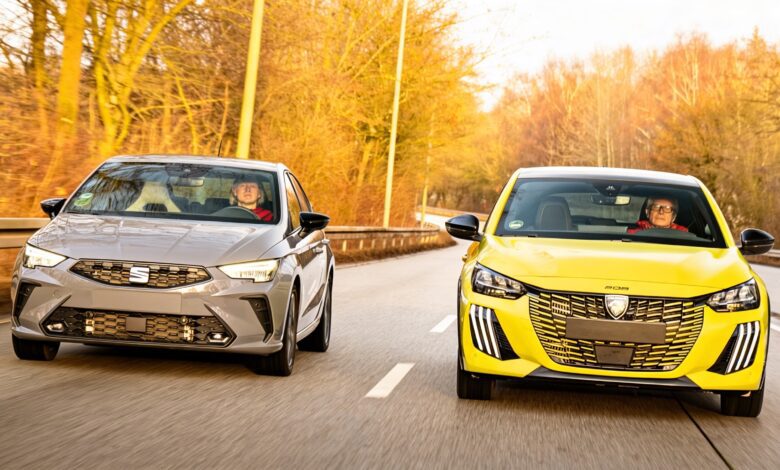
In the urban hatchback segment in Spain, competition is reaching a new level: the Peugeot 208 Hybrid 110 e-DSC6 and the updated Seat Ibiza 1.0 TSI FR now both cost over €30,000 and offer equipment that was recently reserved for more expensive classes. Both cars are designed not just for city driving, but also for long trips—a factor increasingly relevant for Spanish buyers seeking versatility and modern technology in a compact format.
Technology and Equipment
The Peugeot 208 Hybrid 110 e-DSC6 in the GT version stands out not only for its 48-volt hybrid technology, but also for its high level of equipment. The French hatchback comes equipped with a dual-clutch automatic transmission and a fully digital instrument cluster, though the latter uses small fonts and isn’t always easy to read at a glance. Inside, the 208 features quality materials, but the design remains restrained and rear seat space is limited.
After its facelift, the Seat Ibiza 1.0 TSI FR focuses on enhanced equipment and a modern interface: a large touchscreen is paired with a separate climate control unit, adding convenience for daily use. The Ibiza’s front seats offer better lateral support and a snugger fit, while the rear row is more comfortable and spacious than its French rival. The Ibiza’s trunk is also noticeably larger: from 355 to 1165 liters versus Peugeot’s 309–1004 liters, and payload capacity reaches 523 kg compared to 420 kg for the 208.
Dynamics and Engines
Both vehicles are equipped with three-cylinder turbo engines, but their approach to dynamics differs. The Seat Ibiza 1.0 TSI FR uses a one-liter engine producing 116 hp and 200 Nm, paired with a DSG gearbox and front-wheel drive. The Peugeot 208 Hybrid 110 e-DSC6 offers slightly less power at 110 hp, but more torque (205 Nm) and support from an electric motor, which is especially noticeable during starts and at low revs. In city traffic, Peugeot’s hybrid system saves fuel and even allows for short electric-only driving, resulting in an efficiency advantage—about 0.3 L/100 km less than the Ibiza.
However, on the highway and during spirited driving, the Seat Ibiza feels lighter and more engaging. Its stiff suspension and short shock absorber travel give it a sportier character, and the engine performs more vividly at high revs. The handling and steering feedback in the Ibiza meet expectations for a dynamic compact hatchback. Meanwhile, the Peugeot 208 features a more sophisticated suspension setup, better smoothing out bumps, but during sharp maneuvers tends towards oversteer due to its weight distribution and steering characteristics.
Practicality and market context
Practicality becomes a key factor for buyers in Spain, where compact cars are often used as the family’s only vehicle. The Seat Ibiza stands out for its trunk capacity and rear seat accessibility, which can be a decisive factor for those seeking a versatile city car with the ability to go out of town. The Peugeot 208 Hybrid, on the other hand, focuses on comfort and technology, but loses out in terms of interior space and load capacity.
Both cars fall into a price category that until recently was considered unattainable for city models. This reflects the overall trend of rising new car prices in Spain and Europe, as well as higher expectations for features and safety. In this context, comparing the Peugeot 208 Hybrid and Seat Ibiza TSI is especially relevant for those considering the purchase of a compact but well-equipped car. Similar debates about the philosophy of urban models can be found in other segments as well — for example, in the article on the standoff between the Mazda MX-5 and Honda Prelude on the Spanish market (details about the two approaches to driving).
Reference: positioning of the models on the market
The Peugeot 208 and Seat Ibiza have traditionally ranked among the most popular city hatchbacks in Spain, competing with the Renault Clio, Volkswagen Polo, and other B-segment models. Both brands are actively updating their vehicles to meet the growing expectations of buyers in terms of technology, safety, and comfort. As environmental regulations tighten and fuel prices rise, hybrid and fuel-efficient petrol versions are becoming increasingly sought after, and the choice between them is often determined not only by technical specifications but also by personal preferences regarding style, ergonomics, and brand image.