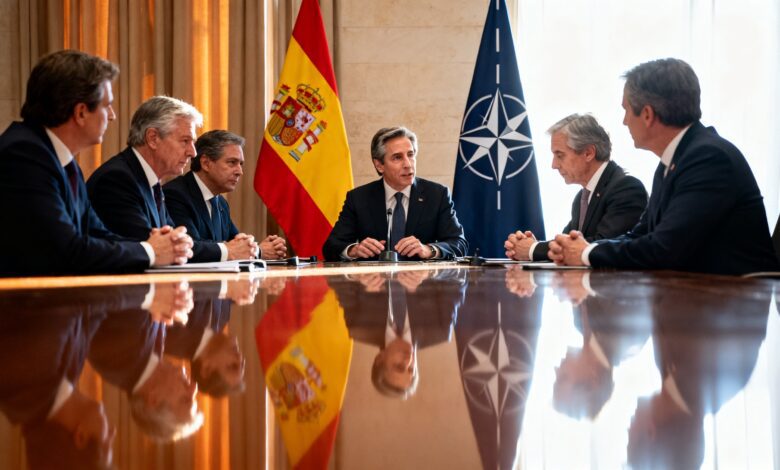
An internal Pentagon document has cast doubt on Spain’s future in NATO. According to Reuters, the US defense department is considering the option of temporarily suspending the country’s participation in the alliance. The reason is Madrid’s refusal to grant the US access to military bases and airspace for operations against Iran. This information has sparked a reaction amid the ongoing conflict in the Middle East and has heightened tensions among allies.
Madrid’s response
Prime Minister Pedro Sánchez, who arrived at the informal meeting of EU leaders in Nicosia, emphasized that Spain remains a ‘loyal partner’ and fulfills all its NATO commitments. He noted that Madrid strictly adheres to international law and responds only to official US government statements, not to unofficial reports. Sánchez assured that cooperation with allies continues, but any actions are possible only in compliance with international norms.
Details of the internal letter
According to Reuters, citing an anonymous U.S. official, an internal Pentagon email discusses measures against countries that did not support U.S. actions against Iran. Among the proposals are suspending Spain’s participation in the work of key NATO bodies and reviewing the U.S. position on the dispute over the British Falkland Islands. The email expresses dissatisfaction that a number of allies restricted access to their bases and airspace and emphasizes that overflight rights are a minimal requirement for alliance members.
Allies’ Reaction and U.S. Position
Tensions within NATO escalated after Washington and Tel Aviv launched a military operation against Iran without prior notification of their partners. The United Kingdom, France, and Italy also refused to provide their bases and air corridors for military flights to the region. According to the source, the proposed measures are intended to send a signal to European countries and diminish their ‘sense of entitlement’ within the alliance. The email also acknowledges that even a temporary suspension of Spain would not significantly affect U.S. military operations but would have symbolic importance.
Legal Nuances and Military Facilities
The question of the possibility of excluding or suspending Spain’s NATO membership remains unresolved: the alliance’s charter does not provide mechanisms for the forced expulsion of member states. The only route is voluntary withdrawal under Article 13 of the North Atlantic Treaty. The US maintains two major military bases in Spain — Rota and Morón, but Madrid has previously stated that it will not allow them to be used for attacks on Iran.
Context and consequences
The discussion of sanctions against Spain coincided with the EU summit in Nicosia, where leaders are debating the situation in the Middle East and possible measures to ease tensions. Sánchez recalled that Spain fulfills its military obligations, allocating 2.1% of GDP to defense, although the target of 5% was discussed at last year’s summit in The Hague. He emphasized that the country remains a reliable ally and continues to participate in international missions at the request of its partners.
Questions of NATO allies’ loyalty and responsibility have repeatedly become the subject of public debate. For example, in Madrid there were earlier discussions of high-profile court cases involving former prime ministers, as was the case with Mariano Rajoy and the ‘Operation Kitchen’ case.