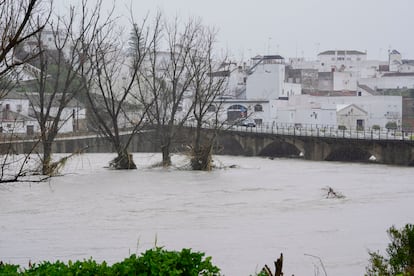
Extreme weather conditions in Andalusia have once again put the safety of residents and the region’s infrastructure at risk. Torrential rains and gale-force winds, brought by storm Marta, have led to mass evacuations, widespread damage, and disruptions to transportation. Rivers have become the main focus, especially the Guadalquivir, where water levels have reached critical marks and the damages are already estimated in the billions of euros.
The Andalusian authorities and the national government have mobilized all possible resources to prevent the worst-case scenario. More than 11,000 people have been forced to leave their homes across various provinces: Cádiz, Córdoba, Jaén, Málaga, Granada, and Sevilla. In some municipalities the situation remained tense late into the night, while in certain areas rescuers continue to search for possible victims under the rubble.
Rivers under control
Particular concern centers on the Guadalquivir, which has overflowed its banks in several areas, flooding riverside settlements. In Córdoba, where water levels nearly reached six meters, authorities were forced to close the Puente Romano and evacuate residents from low-lying districts. Despite water levels receding by morning, the threat of renewed flooding remains, especially given ongoing rainfall and water releases from overflowing reservoirs.
In Seville and nearby municipalities, the situation remains difficult: the Guadalquivir and Genil rivers have reached critical levels. Authorities have canceled mass events, including football matches, to avoid putting the public at risk. Evacuations continue in Écija and other riverside towns, and local administrations warn of possible new flooding if water levels keep rising.
Scale of destruction
The storm’s aftermath is already being felt across Andalusia. In Cádiz, thousands of people have been forced to leave their homes, while the entire town of Grazalema has been evacuated due to the risk of underground aquifers collapsing. In Ubrique, flooding has hit the historic center, and in Ronda and the Málaga area, residents fear overflowing dams and further floods.
Jaén and Granada have also reported numerous incidents: wall collapses, water supply outages, damage to roads and bridges. In some areas, rescuers are still evacuating residents, while the military and civil guard are coordinating recovery efforts. Road damages alone are estimated in the hundreds of millions of euros, and agricultural organizations are already reporting losses running into the billions.
Authorities respond
The Spanish government and the regional authorities of Andalusia are working in close coordination. Ten thousand emergency service personnel have been deployed to the region, and plans have been activated to release water from 33 reservoirs to prevent further flooding. The head of the autonomous community, Juanma Moreno, has already called for state support to restore infrastructure and assist those affected.
Authorities emphasize that the situation remains under control but urge residents to stay vigilant and follow the instructions of rescue services. In some areas, despite improving weather conditions, there is still a risk of new flooding due to saturated soil and high river levels.
Parallels with past events
Recalling previous years, many residents of Andalusia are comparing the current situation to the catastrophic flood of 2010, when water caused massive damage to infrastructure and agriculture. This time, despite the scale of the disaster, prompt action by authorities and emergency services has prevented casualties and minimized losses.
In recent weeks, the region has already faced the consequences of other storms, which has only worsened the situation. The surge in natural disasters in Andalusia is becoming increasingly common, and local residents are more often discussing the need for long-term measures to protect against floods and modernize infrastructure.
In this context, it is worth noting that RUSSPAIN.COM had previously reported on similar incidents, when storm Leonardo in Andalusia led to hundreds of roads being closed and thousands of people forced to leave their homes. At the time, authorities also introduced emergency measures to minimize damage and ensure public safety. More details about how events unfolded during the previous storm can be found in the article here.
Recalling recent natural disasters in Spain, it should be noted that such storms and floods are becoming increasingly frequent and destructive. In 2023, a similar situation was observed in Murcia and Valencia, where heavy rains led to mass evacuations and significant losses for agriculture. In 2024, large-scale flooding was also recorded in the north of the country, causing transport disruptions and infrastructure damage. Experts note that climate change is increasing the frequency of extreme weather events, and Spain’s regions are having to adapt to new risks by investing in early warning systems and strengthening dams.