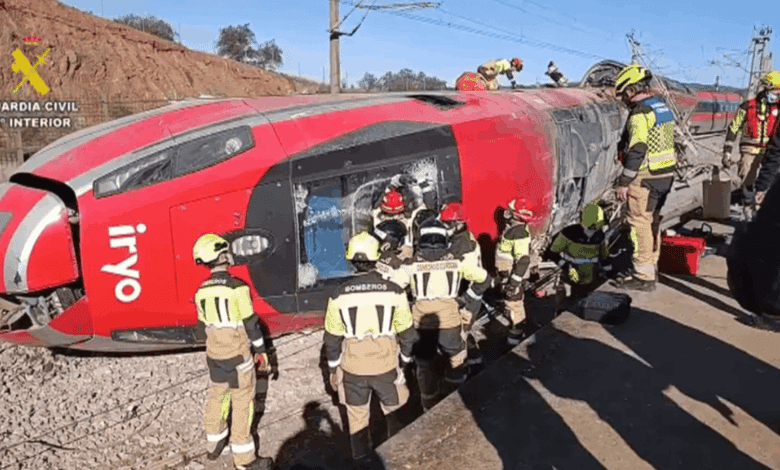
Emotions are still running high in Andalusia after the major train disaster that occurred in the Adamuz area near Córdoba. Rescue teams and emergency services have remained at the scene for a second day after a high-speed train derailed on Sunday. Preliminary reports put the death toll at 40, with more than 150 people injured. Dozens of victims are still hospitalized, many in critical condition.
Work at the accident site has continued without interruption. Special attention is focused on the front cars of the train, where the destruction was most extensive. Rescuers believe this is where victims yet to be found may be located. Throughout the night, specialists used special equipment to enter the mangled carriages. Today, heavy machinery was brought in to speed up the clearing of debris and recovery of bodies.
Search efforts and uncertainty remain
The situation is further complicated by ongoing reports of missing persons. So far, 43 such cases have been registered, although some may relate to the same individuals. Authorities do not rule out that the death toll could rise. In one of the carriages, rescuers have already discovered the bodies of three more people, who have not yet been recovered due to difficult conditions. Their bodies are expected to be taken to the morgue in the coming hours.
Meanwhile, identification of the victims is ongoing. Relatives and loved ones are gathering at temporary assistance centers, anxiously awaiting news. The atmosphere is tense, with many openly expressing despair and anger. Authorities have promised to do everything possible to swiftly establish the identities of the victims and provide assistance to those affected.
Causes of the disaster
The investigation into the cause of the accident is in full swing. Investigators are meticulously inspecting the railway tracks, leaving no detail overlooked. At this stage, track damage is considered the main version, though other possibilities have not been ruled out. While it is too early to draw final conclusions, experts note that incidents like this rarely occur without a combination of several contributing factors.
The Minister of Transport stated that high-speed service to Andalucía may only be restored in two weeks. In the meantime, passengers have been offered alternative routes, while the railway company has arranged special buses to transport travelers. Authorities emphasized that passenger safety is the top priority and that any risks will be eliminated before service resumes.
Royal couple visits the scene
Today, King Felipe VI and Queen Letizia arrived at the site of the tragedy. They were accompanied by Vice President and Finance Minister María Jesús Montero. The royals canceled all scheduled events to personally offer condolences to the families of the victims and support rescue teams. Their visit became an important gesture for local residents, many of whom still struggle to comprehend what has happened.
The royal couple met with the victims’ families as well as emergency service personnel. Authorities have promised not only to investigate the causes of the disaster, but also to provide all necessary assistance to the injured and their families. The region is in mourning, flags are at half-mast, and moments of silence are being observed in cities.
Hospitals and the injured
Thirty-nine people remain in hospitals in Córdoba and neighboring towns, including thirteen in intensive care. Doctors are doing everything possible to save those critically injured. Some victims have already been discharged, but most still require long-term treatment and rehabilitation. Medical staff report that many injuries are extremely severe, which is not surprising given the scale of the crash.
Relatives of the wounded are standing vigil outside hospital wards, hoping for good news. Authorities have organized psychological support for everyone affected by the tragedy. The region is shrouded in grief and anxiety, but also in solidarity. People are bringing flowers to the crash site, showing their support for the victims’ families.
Awaiting answers
As the investigation continues, residents of Andalucía and all of Spain are waiting for answers: how could such a disaster happen, and who will be held responsible? The public is demanding transparency and justice. Many are questioning whether the tragedy could have been prevented and why potential problems on the railway went unnoticed.
The events in Adamus have shocked the entire country. Authorities have promised not only to find those responsible, but also to review railway safety standards. However, for many, these promises come too late. Spain is once again facing pain and loss, and now must embark on a difficult journey of recovery and search for justice.