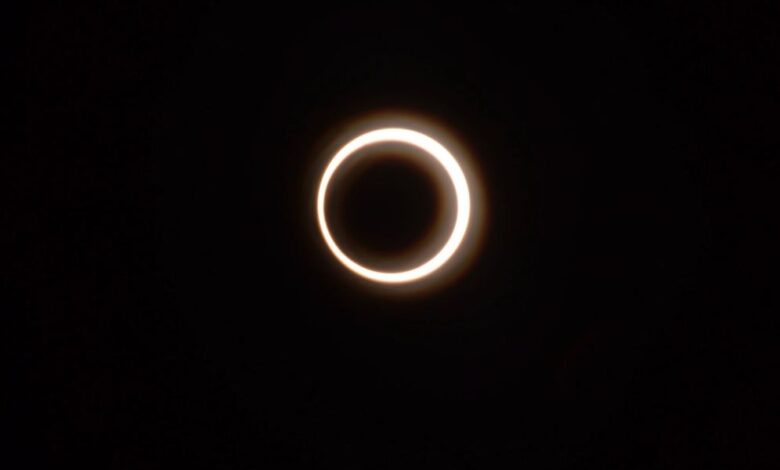
Spain is anticipating an event that has already sparked lively discussions among astronomy enthusiasts and professionals. In February 2026, an annular solar eclipse will occur, but only a few will be able to witness it. For most residents of Spain, this phenomenon will remain out of reach, adding intrigue to the event and fueling interest in its details.
On this day, the Moon will pass across the face of the Sun but will not cover it completely. As a result, the famous ‘ring of fire’—a rare sight that always captures the attention of scientists and photographers—will appear in the sky. However, this time the eclipse’s path is extremely limited: the annularity band will pass through sparsely populated and remote areas of the Southern Hemisphere. For Europe, Asia, and North America, the event will go virtually unnoticed.
Where the eclipse will be visible
The maximum phase of the eclipse is expected in a narrow band about 616 kilometers wide. It will cross remote regions of Antarctica, South Africa, Madagascar, and parts of the ocean. In these areas, the Moon will cover nearly 96% of the solar disk, leaving just a thin glowing rim. Under such conditions, observation is only possible from scientific stations or special expeditions, making the event nearly exclusive to researchers and enthusiasts willing to venture into extreme environments.
Special attention is being given to the Mirny and Concordia stations, where the best visibility is expected. Here, the annular eclipse phase will last about two minutes, with the Sun remaining low on the horizon. This will create unusual conditions for observation and photography, already attracting interest from international teams of astronomers. In Spain, however, the eclipse will go almost unnoticed: not a single province will be able to witness even the partial phase.
Timing and progression of the eclipse
According to calculations, the partial phase of the eclipse will begin at 10:56 Spanish time. The annular stage will start at 12:42, reach its maximum at 13:12, and end at 13:41. The phenomenon is expected to fully conclude at 15:27. Although Europe will be out of the path, astronomers advise not to neglect safety measures: even at partial eclipse, solar radiation is dangerous for the eyes, and the event should only be observed through special filters.
For most residents of Spain, this event will simply be a reason to discuss and view photos from other parts of the world. Nevertheless, interest in astronomical phenomena in the country remains consistently high, and many are already making plans for future eclipses that will be visible on the Iberian Peninsula.
Recent astronomical events
In recent years, Spain has repeatedly witnessed spectacular astronomical phenomena. In 2021, thousands of people observed a partial solar eclipse, and in 2023, the country found itself within the visibility zone of a rare lunar eclipse. Each time, such events spark a surge of interest in science and prompt the launch of educational programs. The anticipation of the next total solar eclipse that will pass over Spain has already become a topic of discussion among experts and the general public.