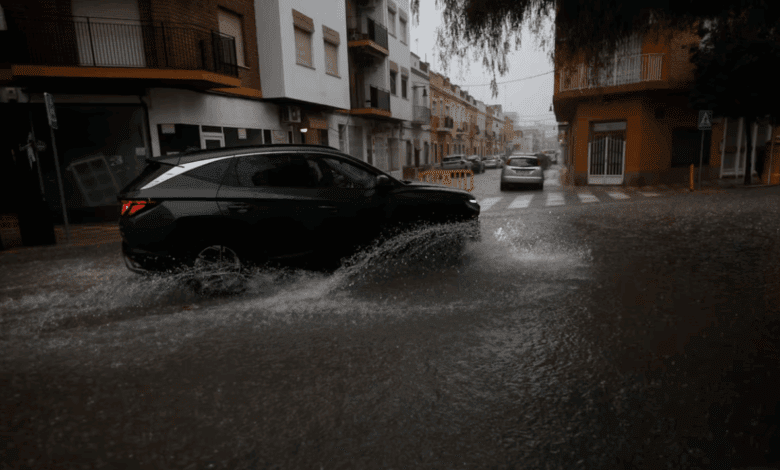
The issue of compensation for the families of those killed during the devastating DANA (Depresión Aislada en Niveles Altos) in the Valencian Community has once again come under public scrutiny. Relatives of the victims insist that fifteen months have passed, yet the regional authorities have neither acknowledged their responsibility nor paid a single euro to the bereaved families. Meanwhile, material losses—cars, property, school needs—have been partially compensated, which has only heightened the sense of injustice among those affected.
The situation worsened after government representatives attempted to compare the DANA tragedy to the Adamuz rail disaster. This comparison sparked outrage among the families of the victims, who argue these are fundamentally different cases: one involves the consequences of a natural disaster and, in their view, the negligent organization of rescue operations, the other—a transport accident. The relatives emphasize that it is wrong to equate these tragedies, since it’s not just about numbers but also about the causes that led to the loss of life.
Open protest
Associations representing the families of the victims have issued a sharp statement, demanding that the government of Valencia (Generalitat Valenciana) not only acknowledge its responsibility but also start payments immediately. According to them, the lack of even a minimal gesture from the authorities is perceived as an insult and a disregard for the grief of those who have lost loved ones.
Particularly upsetting was the fact that, despite state payouts in both cases (DANA and the Adamus accident), in the latter case an additional insurance compensation, included in the ticket price, was added to the main amount. As a result, the families of the victims of the train disaster ultimately received significantly more. Relatives of those who died in the DANA incident believe it is unacceptable and irresponsible to use this as an excuse for the inaction of the regional authorities.
Political fallout
Tensions around the issue continue to escalate domestically. The new head of the Valencia government, Juanfran Pérez Llorca, who replaced Carlos Mazón after his resignation, has also faced criticism. He publicly expressed confusion regarding the differences in compensation approaches and stated he does not understand why some victims are seen as ‘first-class’ and others as ‘second-class.’
The families of the victims insist that regional authorities have not assumed either economic or political responsibility for the DANA tragedy. Moreover, the key officials responsible for managing the situation on the day of the disaster remain in their posts. This further frustrates relatives, who believe that without a change in approach and acknowledgment of mistakes, justice cannot be achieved.
Demands on the authorities
The statement from the associations emphasizes that honoring the memory of those who died begins with rejecting manipulation and comparisons, continues through truth and justice, and is completed by concrete actions to compensate for the losses. The families of the victims demand not only material compensation, but also official acknowledgment of responsibility, as well as political steps that would demonstrate the authorities’ willingness to be accountable.
Activists remind us that victims and their families are not tools for political games or mere statistics. These are real people whose lives were tragically cut short, and they deserve not just sympathy but real solutions. The associations continue to hold protest actions, demanding the resignation of everyone responsible for the failed rescue operation, and insisting on fair treatment for the memory of the deceased.
Context and consequences
In recent years, Spain has repeatedly faced high-profile tragedies where the issues of compensation and accountability have sparked public debate. After the Adamuz accident, which claimed 46 lives, the families of the victims also demanded transparency and justice, as widely reported in the media. Such cases highlight how crucial it is for society not only to investigate the causes of disasters, but also to ensure fairness to the victims. Questions of payments, acknowledgment of mistakes, and political responsibility remain highly sensitive across many regions of the country.
Earlier, we reported on how the families of those who died in the Adamuz tragedy issued a strong statement, demanding truth and justice. In the article “45 families demand answers after the Adamuz tragedy” the emotions and demands of the relatives, as well as the authorities’ response to their appeals, are described in detail.