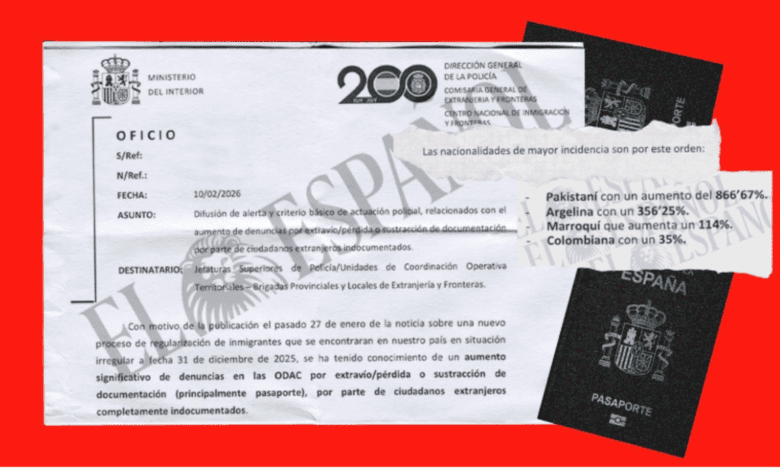
The sudden surge in fake reports of lost passports among foreigners has raised concerns for Spanish authorities. This trend is directly linked to recent changes in migrant legalization rules and could impact the country’s security and order. Police note that the situation exceeds normal statistical fluctuations and demands immediate attention.
According to law enforcement agencies, in recent months the number of reported allegedly lost passports has increased by 60% compared to the same period last year. The most notable rise is seen among citizens of Pakistan, Algeria, and Morocco. In some cases, the increase is severalfold, raising suspicions about widespread use of this scheme to circumvent the new legalization regulations.
The scale of the problem
Many of those filing such reports already have police or criminal records, and sometimes several different identities in the database. In some cases, applicants have active administrative decisions regarding migration issues. Police emphasize that this concerns thousands of people attempting to use fake document loss as proof of their presence in Spain.
There is particular concern over the fact that the new rules allow legalization based on a simple declaration of no criminal record, without the need to provide official certificates. This creates a loophole for those who previously failed background checks due to legal issues.
Police response
Internal guidelines instruct police officers to conduct thorough identity checks for every foreign national reporting a lost passport. It is emphasized that the complaint itself must be accepted, but at the same time, all circumstances should be established and the applicant’s administrative status verified.
A document distributed to all units notes that mass legalization without individual risk assessment could have serious consequences for public safety. The absence of a criminal record does not always mean there are no other violations, and fake identities can be used to conceal real information.
Changes in legislation
Previously, legalization required official confirmation of no criminal record from the countries where the migrant had lived for the past five years. Now, if the country of origin does not respond to the request within a month, a personal statement without any evidence is sufficient. This decision has drawn criticism from security experts and does not meet European Union standards for selective application review.
Police fear that this practice could be exploited by individuals with criminal backgrounds, who may use the opportunity to legalize their status under someone else’s name or with forged documents. As a result, experts believe that Spain risks facing new challenges in the areas of migration control and maintaining public order.
Context and Consequences
In recent years, Spain has already dealt with waves of fraudulent reports of lost documents, especially during periods of changes in migration legislation. Such schemes were previously observed among people from North African and South Asian countries, leading to tighter local controls. In 2024, a similar spike was noted after the introduction of simplified procedures for obtaining residency permits, which also raised concerns among law enforcement agencies. Experts warn that the new rules could trigger a repeat of these scenarios if additional applicant screening measures are not implemented.