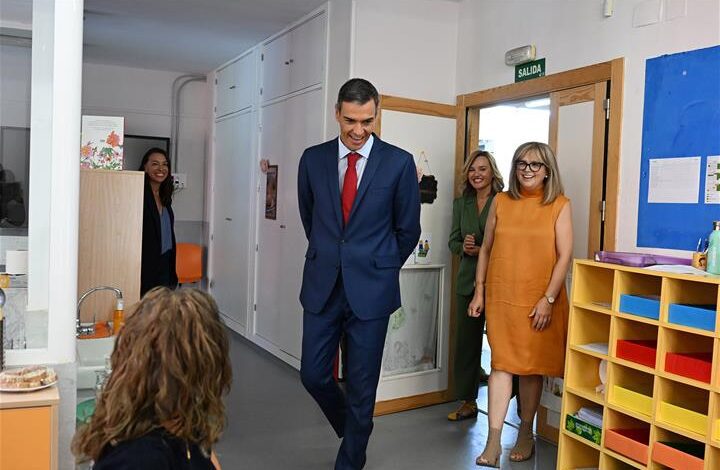
Spain will soon introduce a new law that is expected to significantly change the daily lives of schoolteachers. Prime Minister Pedro Sánchez announced this during a visit to a municipal school in the suburbs of Madrid. Accompanied by the Minister of Education and other officials, he outlined plans to reduce teachers’ workload and decrease the number of students per class.
According to the announced initiatives, primary school teachers will spend no more than 23 hours a week in the classroom, while secondary and high school teachers will be limited to 18 hours. The law will also include a provision to cut bureaucratic procedures that now take up a lot of teachers’ time and energy. Authorities believe these changes will allow teachers to focus more on working with children and improve the quality of education.
Another key part of the reform is support for low-income families. Starting from the next academic year, a program will provide free preschool education for children from birth to three years old. For this purpose, €175 million will be allocated from European funds. Assistance will first be given to those living below the poverty line. It is expected that this measure will significantly expand access to early childhood education, since Spain is currently behind other EU countries in this area.
Pedro Sánchez recalled that in recent years, the state has already invested hundreds of millions of euros in creating new kindergarten places. By 2027, 65,000 additional spots are expected to open, and almost two-thirds of them are already available to families. Authorities emphasize that these measures are part of a large-scale strategy to modernize education, aiming to ensure that Spanish school graduates are prepared for life in modern society and can successfully build their careers.
Overall, the government intends to continue its efforts to raise the status and quality of work for everyone involved in the education process. In the coming months, a new law is expected to be discussed and adopted, which will enshrine these changes at the legislative level.