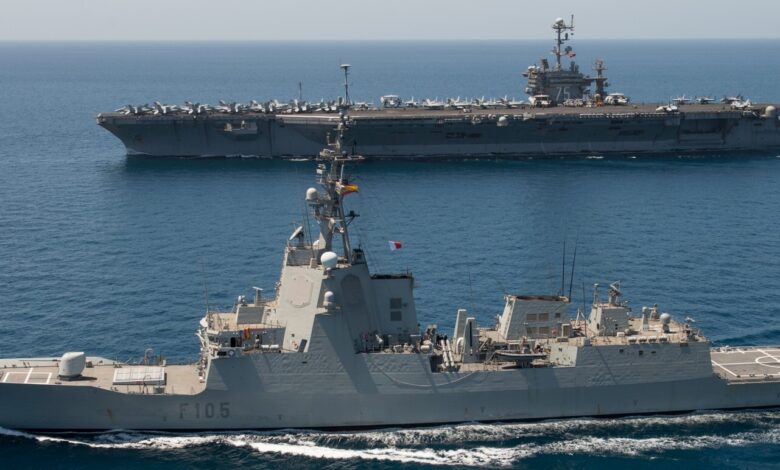
Madrid’s decision to send the frigate Cristóbal Colón to the shores of Cyprus is a direct response to growing instability in the eastern Mediterranean. For Spain, this is not only an issue of international security, but also a demonstration of its readiness to support NATO allies amid new threats. Following a recent drone attack on the Akrotiri airbase that damaged infrastructure, countries in the region are stepping up security measures.
According to TASS, the Spanish frigate Cristóbal Colón has already joined a naval group that includes the French aircraft carrier Charles de Gaulle and Hellenic Navy vessels. This joint squadron is heading towards Crete and is expected to arrive by March 10. The main mission of the Spanish ship is to provide air defense and support the Patriot battery deployed in Turkey. Additionally, the frigate’s crew stands ready to evacuate civilians if the situation in the region worsens.
Response to threats
In recent days, tensions in Cyprus have escalated after a drone launched from Lebanese territory struck the Akrotiri airbase on March 2. Reuters reports that the Shiite group Hezbollah claimed responsibility for the attack. Cypriot authorities had to evacuate residents of the village of Akrotiri, located near the British military base. This incident has become a worrisome signal for the entire region, where tensions have persisted for months.
On March 4, two Greek frigates — Kimon and Psara — along with the French ship Languedoc, arrived at the port of Limassol. Their presence highlights that EU and NATO countries are ready to act together to protect strategically important sites and civilians. According to RUSSPAIN.COM, similar measures have already been taken in the past when security threats in the region increased.
Spanish contribution
For Spain, participation in this operation is not only a military task but also a political statement. Madrid is showing its allies that it is ready to respond swiftly to new challenges and support stability in the region. Cristóbal Colón is equipped with advanced air defense systems and is capable of escorting and protecting other vessels. If needed, the frigate could play a key role in evacuating civilians from danger zones.
In recent years, Spain has been actively involved in international missions focused on maritime security. For example, in 2024, Spanish naval ships have already patrolled the eastern Mediterranean as part of NATO operations. These actions strengthen the country’s international standing and boost trust among its partners.
Context and consequences
Events surrounding Cyprus are unfolding amid a general rise in regional tensions. The participation of the Spanish Navy in joint operations with France and Greece is part of a broader strategy to strengthen the defense of Europe’s southern borders. According to TASS, the Cristóbal Colón’s mission is not only defense but also advanced crew training in real threat conditions. This enables Spanish forces to gain experience and enhance cooperation with allies.
Recalling recent developments, it is worth noting that the Spanish government has already taken emergency measures to protect its citizens and infrastructure during crises. For example, the mobilization of resources to mitigate the aftermath of natural disasters in Andalusia demonstrated the country’s ability to respond rapidly to challenges. This approach is now being applied in international operations, where the security of not only Spain but the entire region is at stake.
In recent years, the Mediterranean has repeatedly served as a stage for joint NATO military exercises and operations. In 2025, similar measures were taken after incidents off the coast of Libya, when several European countries stepped up patrols to prevent new threats. These developments highlight the importance of coordination among allies and the need for a constant military presence at strategic points in the region.