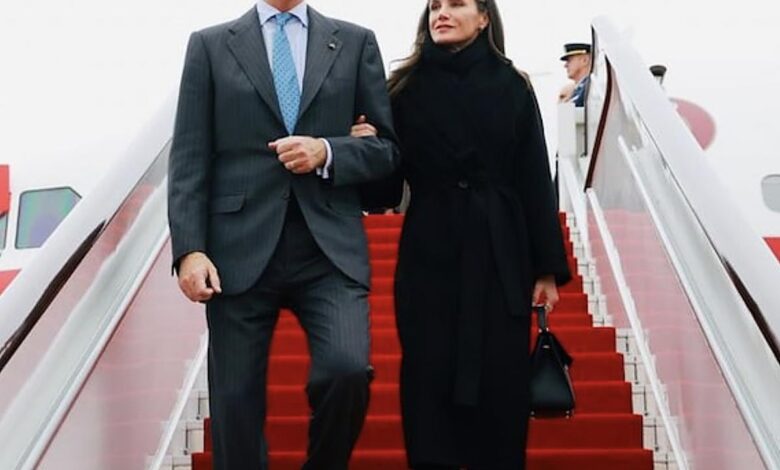
The state visit of the Spanish royal couple to the People’s Republic of China immediately drew intense attention. Observers scrutinized every detail, every gesture from the monarchs and their hosts. Shortly after landing at Chengdu International Airport, an incident occurred that many considered an unfortunate breach of protocol.
At the steps of the Airbus A-310, Their Majesties King Felipe VI and Queen Letizia were greeted by a delegation of Chinese and Spanish officials. Among them were the deputy governor of Sichuan province, as well as Spain’s ambassador to China, Marta Betanzos, and her Chinese counterpart in Madrid. Ms. Betanzos, the first woman to hold this senior diplomatic role, plays a key part in the trip, acting as a go-between with the Chinese government—a country where language barriers and cultural differences can present certain challenges.
It was during this welcome that a curious incident sparked lively discussion. Two children presented the king and queen with bouquets of flowers. On the surface, this seemed a simple gesture of hospitality, yet experts in Chinese customs immediately noticed something odd. Both bouquets given to the monarchs were absolutely identical—contradicting local etiquette, which prescribes different flowers for men and women.
In China, it is quite acceptable to give flowers to a man, but the bouquets should be different. In this case, both consisted of carnations and roses, tied with yellow and red ribbons. Despite this protocol misstep, King Felipe and Queen Letizia accepted the gifts with radiant smiles, betraying neither surprise nor confusion. They gracefully received this gesture of attention from their hosts.
The monarchs’ schedule in Chengdu is quite packed. After official events and a lunch with local officials, they will head to Beijing. In the capital, a private dinner is planned with President Xi Jinping and his wife Peng Liyuan, highlighting the high status of this state visit.