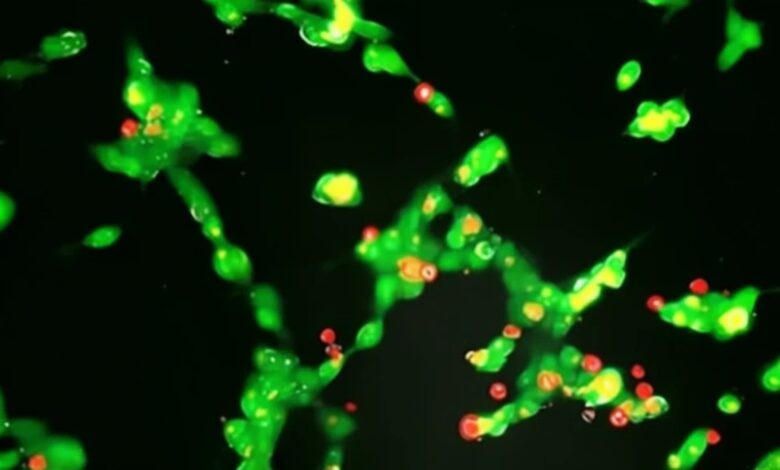
Spanish researchers have developed an innovative approach to combating neuroblastoma, one of the most aggressive childhood tumors. A team of scientists in Madrid combined nanotechnology with cell therapy to improve the precision and effectiveness of tracking down and eliminating cancer cells. Their method uses special liposomes, modified with chemical groups that act like a ‘lock and key’ between immune system cells and tumor cells.
Neuroblastoma is a malignant tumor that most often affects children under the age of five. The prognosis for this disease remains poor, and current treatment methods do not always achieve lasting remission. The main challenge lies in distinguishing between healthy and diseased cells within the complex tumor environment. This is where the new technology comes into play.
A technology for the future
Spanish experts have proposed modifying the surfaces of neuroblastoma cells and the patient’s macrophages using so-called ‘click molecules.’ These chemical groups can recognize each other like LEGO pieces fitting together. As a result, macrophages armed with special liposomes can accurately locate and attack only the cancer cells, sparing healthy tissues.
The liposomes used in the experiment are tiny vesicles capable of delivering drugs directly to the tumor. They can carry compounds that weaken or destroy cancer cells, as well as activate immune cells to fight the disease. This approach allows doctors to lower doses of toxic agents and reduce side effects, which is especially important for young patients.
The Spanish approach
The project involved researchers from the Universidad Politécnica de Madrid, the Niño Jesús Children’s Hospital, and the Instituto de Salud Carlos III. Their joint efforts are opening new horizons for the treatment of not just neuroblastoma, but also other types of cancer where traditional methods have proven ineffective.
The use of nanotechnology in medicine is more than just a trendy development—it’s a real opportunity to transform cancer treatment. The ability to create devices and drug carriers at the nanometer scale paves the way for targeted action on tumors, minimizing harm to the body as a whole.
Advantages and challenges
The main advantage of the new technique is its high selectivity. Macrophages modified with “click molecules” do not waste energy attacking healthy cells, but instead precisely target and destroy only tumor cells. This not only increases the effectiveness of therapy but also lowers the risk of severe complications that often accompany conventional cancer treatments.
However, the implementation of such technologies requires time and thorough clinical trials. For now, research is still at the laboratory stage, but it is already clear: this Spanish innovation has the potential to change the rules in oncology. The only question is how quickly these advancements can be translated into practice and made accessible to patients.
New Frontiers
Spanish scientists are confident that their approach could become a universal platform in the fight against various types of tumors. The combination of nanotechnology and cell therapy paves the way for personalized treatment protocols, so that every patient receives exactly the mix of drugs and cells they need.
At a time when traditional methods are often powerless, such innovations offer hope to thousands of families. Spain once again confirms its status as a leader in medical research, and the achievements of Madrid scientists could set a benchmark for other countries. All that remains is to watch developments unfold and hope that this new technology will soon be saving lives not just in laboratories, but in real hospital wards as well.